
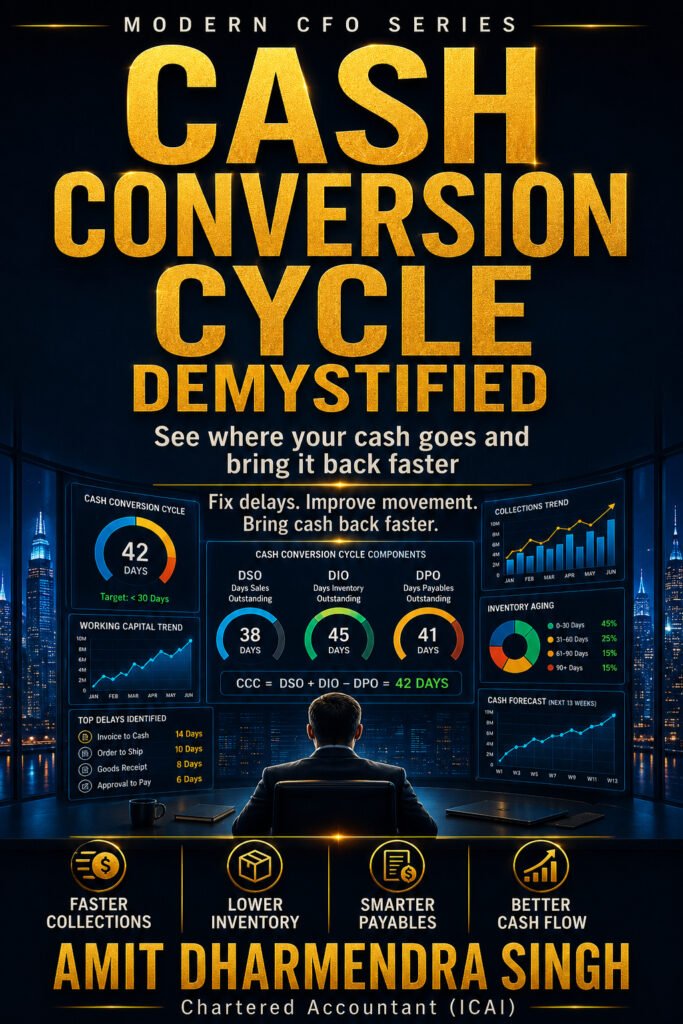
See where your cash goes and bring it back faster
Cash Conversion Cycle Demystified is a practical guide for business owners, finance professionals, and leaders who want to understand how cash moves through their business and why it often gets trapped in receivables, inventory, and day to day operations.
The book breaks down the three core components of the Cash Conversion Cycle: Days Sales Outstanding, Days Inventory Outstanding, and Days Payable Outstanding. It shows how improving these areas can accelerate cash movement, strengthen liquidity, and reduce unnecessary pressure on working capital.
Available Languages & Formats
🇬🇧 English
✅ Kindle
✅ Paperback
✅ Hardcover
✅ Audiobook
Buy on Amazon
Select your preferred Amazon marketplace below. Availability varies by language and format.
If your country is not listed below, you can purchase from Amazon.com (US) or your nearest available Amazon marketplace. Kindle editions can usually be delivered worldwide, subject to Amazon regional availability.
🇬🇧 English
📖 Buy the Book on Amazon – US | UK | DE | FR | ES | IT | NL | JP BR | CA | MX | AU | IN
🎧 Listen on Audible – Audible
What You’ll Learn
Cash Conversion Cycle is about understanding how cash moves through a business, from paying suppliers and managing inventory to collecting money from customers. This book explains how to measure, analyse, and improve the cycle to strengthen liquidity and release cash trapped in operations.
In this book, you will learn how to:
- Understand how the Cash Conversion Cycle affects cash flow and working capital.
- Use DSO, DIO, and DPO to identify where cash is getting stuck.
- Recognise the operational delays, bottlenecks, and habits that silently extend the cash cycle.
- Improve receivables, inventory movement, and payables without damaging business relationships.
- Identify the root causes of slow billing, excess inventory, delayed approvals, and weak communication.
- Create practical routines that improve cash visibility and predict cash pressure earlier.
- Use simple daily and weekly actions to shorten the cash conversion cycle.
- Build stronger coordination between sales, operations, purchasing, and finance.
- Use CCC as a practical leadership dashboard for faster and better decisions.
- Reduce unnecessary dependence on external funding by improving the movement of cash already within the business.
- Turn cash conversion management into a consistent business discipline that supports sustainable growth.
Who Should Read This Book?
This book is designed for finance professionals, business leaders, and decision makers who want to understand how cash moves through their business and improve liquidity by managing receivables, inventory, and payables more effectively.
It is ideal for:
- Chief Financial Officers and Finance Directors
- Finance Managers and Financial Controllers
- Treasury and Working Capital Professionals
- Accounts Receivable and Credit Management Teams
- Accounts Payable and Procurement Professionals
- Supply Chain and Inventory Managers
- Business Owners and Entrepreneurs seeking better cash flow control
- Operations Leaders responsible for improving working capital efficiency
- Consultants and Advisors supporting business performance and financial improvement
Key Topics Covered
Cash Conversion Cycle Demystified provides a practical understanding of how cash moves through a business and how receivables, inventory, and payables influence liquidity, working capital, and overall financial performance.
Topics covered include:
- Understanding the Cash Conversion Cycle and its importance
- Calculating Days Sales Outstanding, Days Inventory Outstanding, and Days Payable Outstanding
- Understanding the relationship between receivables, inventory, payables, and cash flow
- Identifying cash trapped in working capital Improving accounts receivable collection performance
- Managing inventory more efficiently
- Optimising supplier payment terms and accounts payable
- Analysing the impact of the Cash Conversion Cycle on liquidity
- Using working capital metrics to improve business decisions
- Identifying operational bottlenecks that slow down cash conversion
- Balancing growth, profitability, and liquidity
- Developing practical strategies to shorten the Cash Conversion Cycle
- Building stronger cash flow discipline across the organisation
- Using the Cash Conversion Cycle as a strategic performance management tool
Why I Wrote This Book
Throughout my career in finance, I have seen businesses report healthy sales and profits while still struggling with cash flow. In many cases, the issue is not a lack of profitability but cash becoming trapped in receivables, inventory, and inefficient working capital processes.
The Cash Conversion Cycle provides a simple but powerful way to understand how efficiently a business converts its investment in operations back into cash. Yet many business leaders focus heavily on revenue and profit without fully understanding how long their cash remains tied up in the operating cycle.
I wrote Cash Conversion Cycle Demystified to make this important financial concept practical and easy to understand. My objective is to help finance professionals and business leaders look beyond accounting numbers and understand the operational drivers that directly affect liquidity.
This book explains how receivables, inventory, and payables work together to influence the movement of cash through a business. More importantly, it focuses on practical ways to identify inefficiencies, release trapped cash, and improve working capital without compromising business growth.
Cash Conversion Cycle Demystified is intended to help readers turn a financial metric into a practical management tool that supports stronger liquidity, better decision making, and more sustainable business performance.
Inside the Book
Cash Conversion Cycle Demystified is organised into six practical sections that take the reader from understanding the fundamentals of the Cash Conversion Cycle to improving working capital, strengthening liquidity, and creating better control over business cash flow.
The book is organised into six sections:
Section I: Understanding the Cash Conversion Cycle
Understand how cash moves through a business and learn the relationship between inventory, receivables, payables, and working capital.
Section II: Managing Inventory and DIO
Learn how inventory decisions affect cash flow and how Days Inventory Outstanding can be analysed and improved without disrupting business operations.
Section III: Managing Receivables and DSO
Explore credit management, invoicing, collections, and customer payment behaviour to understand how businesses can reduce the time taken to convert sales into cash.
Section IV: Managing Payables and DPO
Understand how supplier payment terms and purchasing practices influence cash flow and how to balance liquidity with strong supplier relationships.
Section V: Measuring and Improving the Cash Conversion Cycle
Learn how to calculate, analyse, benchmark, and improve the Cash Conversion Cycle by identifying where cash is unnecessarily tied up.
Section VI: Working Capital Strategy and Cash Flow Improvement
Build a stronger approach to working capital by connecting operational decisions with liquidity, financial flexibility, and sustainable business growth.
The book is designed to move beyond formulas and into practical application. Each chapter includes explanations, business examples, key takeaways, reflection questions, and practical actions to help readers understand where cash is locked within the business and how working capital performance can be improved.
Frequently Asked Questions
1. What is the Cash Conversion Cycle?
The Cash Conversion Cycle measures the time it takes for a business to convert cash invested in inventory and operations back into cash received from customers. It provides a practical view of working capital efficiency and liquidity management.
2. How is the Cash Conversion Cycle calculated?
The Cash Conversion Cycle is calculated by adding Days Inventory Outstanding and Days Sales Outstanding, then subtracting Days Payable Outstanding. The result shows how long cash remains tied up in the operating cycle.
3. What are DIO, DSO, and DPO?
DIO measures the average time inventory is held before being sold. DSO measures the average time customers take to pay, while DPO measures the average time a business takes to pay its suppliers.
4. Why is the Cash Conversion Cycle important?
The Cash Conversion Cycle helps businesses identify how efficiently they manage working capital. A long cycle may indicate that excessive cash is tied up in inventory or receivables, creating additional pressure on liquidity.
5. Is a shorter Cash Conversion Cycle always better?
Generally, a shorter cycle improves cash availability, but reducing the cycle should not negatively affect customer service, inventory availability, or supplier relationships. The objective is to optimise the cycle rather than simply make it as short as possible.
6. Can a business have a negative Cash Conversion Cycle?
Yes. A negative Cash Conversion Cycle occurs when a business receives cash from customers before it needs to pay suppliers. This can create a strong working capital position depending on the nature of the business model.
7. How can a business improve its Cash Conversion Cycle?
Businesses can improve the cycle by managing inventory more effectively, strengthening credit control, accelerating invoicing and collections, and optimising supplier payment terms.
8. Can a profitable business still have cash flow problems?
Yes. Profitability does not always mean strong cash flow. A growing business can face liquidity problems when large amounts of cash are tied up in inventory and receivables.
9. Who should monitor the Cash Conversion Cycle?
The Cash Conversion Cycle should be monitored by CFOs, finance leaders, working capital managers, business owners, operations leaders, and anyone responsible for improving cash flow and business performance.
10. Is the Cash Conversion Cycle relevant for small and medium sized businesses?
Yes. Businesses of all sizes can benefit from monitoring the Cash Conversion Cycle. For smaller businesses, efficient working capital management can be particularly important because liquidity constraints can directly affect daily operations and growth.
11. How often should the Cash Conversion Cycle be reviewed?
The frequency depends on the nature of the business, but a monthly review is useful for most organisations. Businesses with fast moving inventory or significant working capital requirements may benefit from more frequent monitoring.
12. Is this book theoretical or practical?
It is designed as a practical guide. The book combines financial concepts with business examples, calculations, interpretation, key takeaways, reflection questions, and actionable steps to help readers improve working capital and cash flow.
About the Author
Amit Dharmendra Singh is a Chartered Accountant (ICAI), DISA (ICAI), Finance Executive, Author, and AI in Finance Advocate with more than 23 years of international leadership experience across India, Thailand, and Saudi Arabia. His work focuses on corporate finance, cash flow management, working capital optimization, business transformation, and artificial intelligence in finance.
Through his books, Amit shares practical frameworks and real world insights that help finance professionals, business leaders, and entrepreneurs make better financial decisions and build stronger organizations.
Related Books
📘 Cash Flow Is Strategy, Not an Outcome
Learn how to make cash flow a strategic business discipline that supports liquidity, better decisions, and sustainable growth.
📘 Lean Finance: Removing Waste from R2R, P2P, and O2C
Learn how to eliminate unnecessary work, reduce process delays, and build faster, more efficient finance operations across Record to Report, Procure to Pay, and Order to Cash.
📘 Working Capital Mastery for CFOs
Master strategies to optimize working capital, improve liquidity, and strengthen cash flow.
📘 Financial Transformation in 90 Days
Master practical strategies to transform finance operations, strengthen controls, improve visibility, and build a high performing finance function in 90 days.
📘 The Future CFO: AI, Data & Forecasting
Discover how artificial intelligence, analytics, and forecasting are transforming the role of the modern CFO.
Continue Your Learning
Continue your finance leadership journey with more books, articles, and resources.
Explore More
📚 Explore My Books
Discover the complete collection of books on finance, leadership, artificial intelligence, business strategy, and international trade.
📝 Read the Blog
Explore practical articles, insights, and real world perspectives on corporate finance, cash flow, working capital, AI, and business transformation.
👤 About the Author
Learn more about Amit Dharmendra Singh, his professional journey, and the experience behind every book.
📩 Contact
Have a question, feedback, or would like to connect? Get in touch through the contact page.
→ Contact