
Introduction
ChatGPT in Import Export Business can help importers, exporters, traders and sourcing professionals handle many of the research and planning tasks involved in international trad
International trade involves research, sourcing, sales, documentation, logistics, finance and constant decision making.
For an importer or exporter, even a relatively simple transaction can require answers to dozens of questions.
Which products should I trade?
Which markets should I target?
How do I find reliable suppliers?
Who are the right buyers?
How should I approach them?
What documents are required?
Which shipping option should I consider?
How can I reduce risk?
How should I structure payment terms?
Traditionally, answering these questions required extensive research, spreadsheets, emails, websites, reports and conversations with different professionals.
Today, ChatGPT can help organize much of this work.
The important point, however, is that ChatGPT should not be treated as a replacement for trade expertise or professional judgment. It is better used as a practical assistant that helps you research, structure information, explore alternatives and prepare for decisions.
The quality of the result also depends heavily on the quality of the question.
A vague question often produces a generic answer.
A well structured prompt can produce a much more useful starting point.
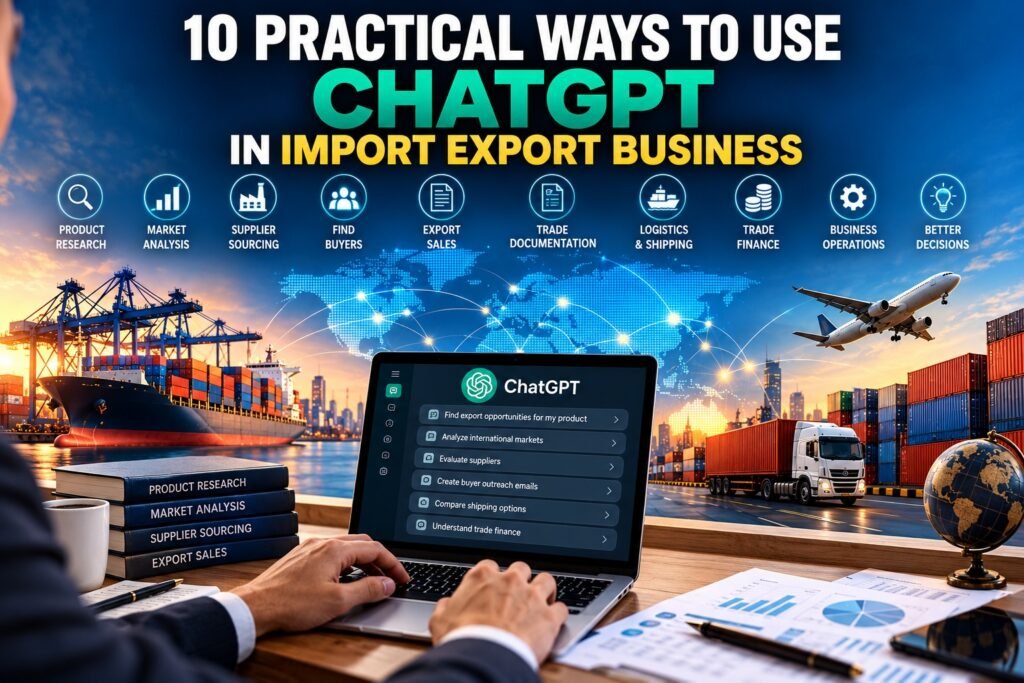
In this article, we will look at 10 practical ways to use ChatGPT in an import export business, from product research and market analysis to supplier sourcing, international sales, logistics, trade finance and business decision making.
The goal is not simply to use AI.
The goal is to use it more effectively.
1. ChatGPT in Import Export Business for Product Research
Choosing the right product is one of the first major decisions in an import export business. A product may look attractive because of current demand or a popular trend, but that does not automatically make it a good business opportunity.
You also need to consider competition, profitability, sourcing complexity, regulations, logistics and long term demand.
This is where ChatGPT in Import Export Business can help structure the initial research process.
Instead of simply asking:
“What products should I export?”
you can give ChatGPT more context and ask it to evaluate several factors at the same time.
Example Prompt
Act as an international trade consultant. Identify 10 product categories with strong international demand. Evaluate each category based on market growth, competition, profit potential, regulatory complexity and suitability for small and medium sized businesses. Present the results in a comparison table.
You can make the analysis more relevant by adding your country, available capital, industry experience, preferred destination markets and logistics capabilities.
You can also ask ChatGPT to compare several products rather than looking at one opportunity in isolation.
Example Prompt
Compare [Product A], [Product B] and [Product C] for an export business from [Country]. Evaluate demand, competition, estimated margins, sourcing complexity, logistics requirements, regulatory considerations and scalability. Present the analysis in a structured comparison table.
The important point is that AI generated research should be treated as a starting point, not as final proof that a product will succeed.
A good product research process combines AI assisted analysis with actual market research, customer feedback, supplier discussions and commercial judgment.
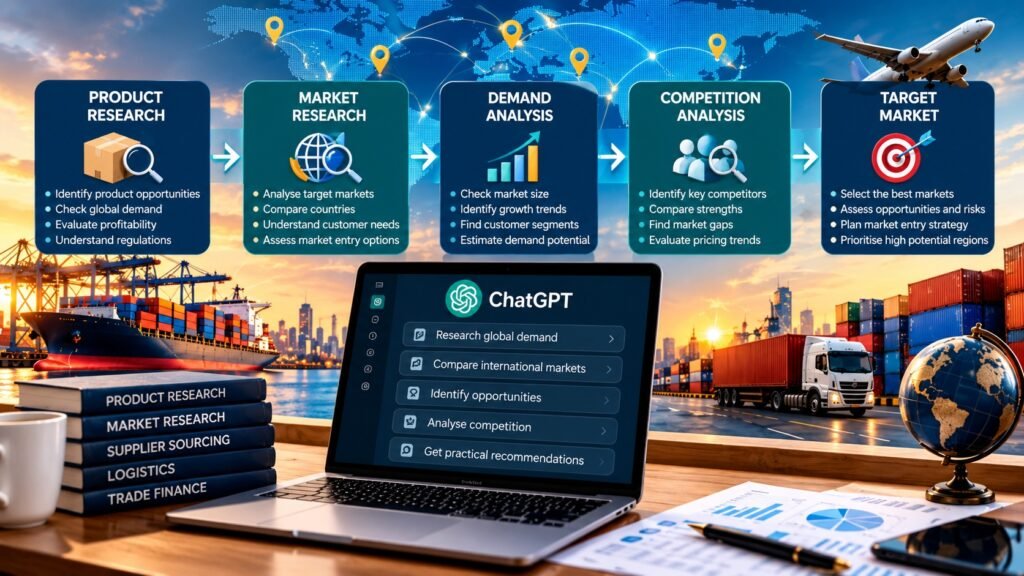
2. ChatGPT in Import Export Business for Market Research
Finding a promising product is only half of the equation.
The next question is:
Where should you sell it?
A product that performs well in one country may face weak demand, strong competition, regulatory barriers or difficult distribution conditions in another.
Market research can help you examine these differences before committing significant resources.
With ChatGPT in Import Export Business, you can structure country and market comparisons around factors such as:
• Market size and demand
• Customer segments
• Competition
• Economic conditions
• Regulatory environment
• Distribution channels
• Logistics considerations
• Market entry barriers
• Growth potential
• Pricing considerations
Example Prompt
Act as an international market research consultant. Evaluate [Country] as a target market for [Product]. Analyze market size, demand, competition, economic conditions, regulatory environment and growth potential. Present the findings in a structured report and identify the key opportunities and risks that an exporter should investigate further.
You can also compare multiple countries:
Example Prompt
Compare [Country A], [Country B] and [Country C] for selling [Product]. Evaluate demand, competition, regulations, logistics, distribution channels and profitability potential. Present the results in a comparison table and identify the key factors that require further verification.
This approach can make your research more structured and help you identify the questions that require deeper investigation.
The objective is not to let AI choose your market for you. The objective is to use AI to organize the research, compare alternatives and identify areas that deserve further investigation.
3. ChatGPT in Import Export Business for Finding Suppliers
Once you have identified a product and a potential market, the next challenge is finding suitable suppliers.
A supplier search should go beyond finding the lowest quoted price. You also need to consider product quality, production capacity, certifications, delivery capability, communication and reliability.
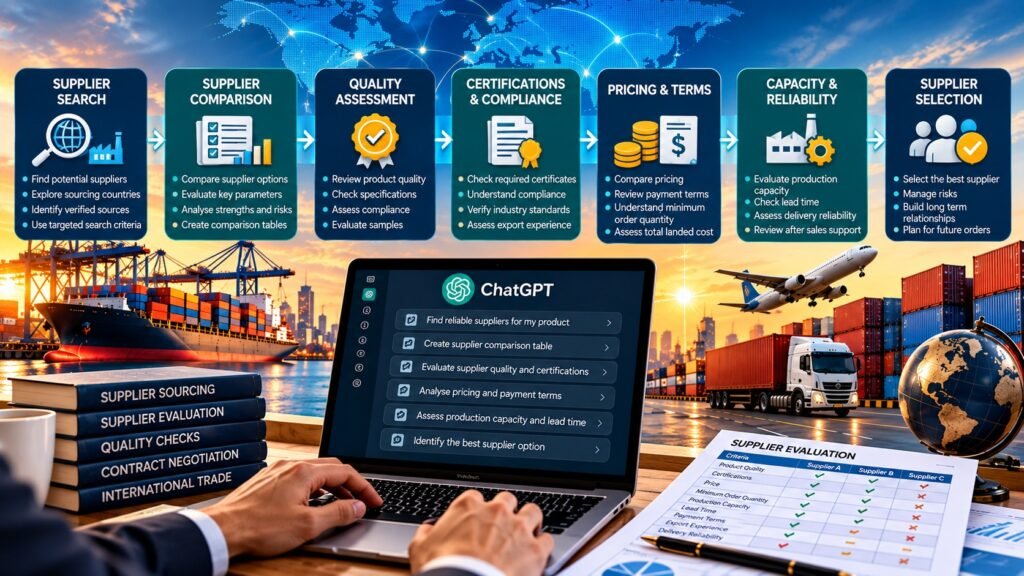
ChatGPT in Import Export Business can help you create a more structured supplier research process.
Instead of asking:
“Find suppliers for my product.”
you can provide more information and ask ChatGPT to create a supplier search framework.
Example Prompt
Act as an international sourcing consultant. Help me identify suitable supplier profiles for [Product]. My target sourcing countries are [Countries]. My expected monthly requirement is [Quantity]. Create a supplier evaluation framework covering product quality, production capacity, certifications, pricing, minimum order quantity, lead time, export experience and payment terms.
You can also use ChatGPT to prepare a supplier information checklist before contacting potential suppliers.
For example, you can ask:
Create a detailed supplier information checklist for importing [Product] from [Country]. Include questions about product specifications, quality standards, certifications, production capacity, minimum order quantity, lead time, packaging, payment terms, export experience and after sales support.
This makes the supplier search more systematic and helps you collect comparable information from different suppliers.
However, ChatGPT should not be treated as proof that a particular supplier is genuine or reliable. Supplier information, certifications, company details and commercial claims should be independently verified before placing an order.
Your book specifically emphasizes using AI to support supplier sourcing while applying proper evaluation and verification. The supplier sourcing section covers identifying, evaluating, negotiating with and managing international suppliers.
4. ChatGPT in Import Export Business for Supplier Evaluation
Finding suppliers is only the beginning.
The next step is determining which suppliers deserve further consideration.
A supplier may offer an attractive price but have limited production capacity. Another may have excellent quality but long lead times. A third may have the right certifications but require payment terms that create cash flow pressure.
This is where ChatGPT in Import Export Business can help you build a supplier comparison framework.
You can provide information collected from different suppliers and ask ChatGPT to organize it into a structured comparison.
Example Prompt
Compare the following three suppliers for [Product]. Evaluate product quality, price, minimum order quantity, production capacity, certifications, lead time, payment terms, export experience and delivery reliability. Create a supplier comparison table and identify the key strengths, weaknesses and information gaps that require further verification.
You can take the analysis further by asking ChatGPT to create a supplier scorecard.
Example Prompt
Create a weighted supplier evaluation scorecard for [Product]. Assign appropriate weights to quality, price, production capacity, certifications, lead time, payment terms, export experience and reliability. Provide a scoring system that can be used to compare multiple suppliers.
This can be particularly useful when you are dealing with several potential suppliers and need a consistent way to organize the information.
The objective is not simply to find the cheapest supplier.
The objective is to understand the overall commercial value and risk associated with each supplier.
The final decision should still be based on verified information, supplier discussions, samples where appropriate, commercial terms and proper due diligence.
5. ChatGPT in Import Export Business for Finding International Buyers
Finding a good product and reliable suppliers is only part of building an import export business. The next challenge is finding customers who are actually interested in buying the product.
International buyer research can take considerable time because you may need to identify suitable companies, understand their business activities, study their markets and determine whether they could be potential customers.
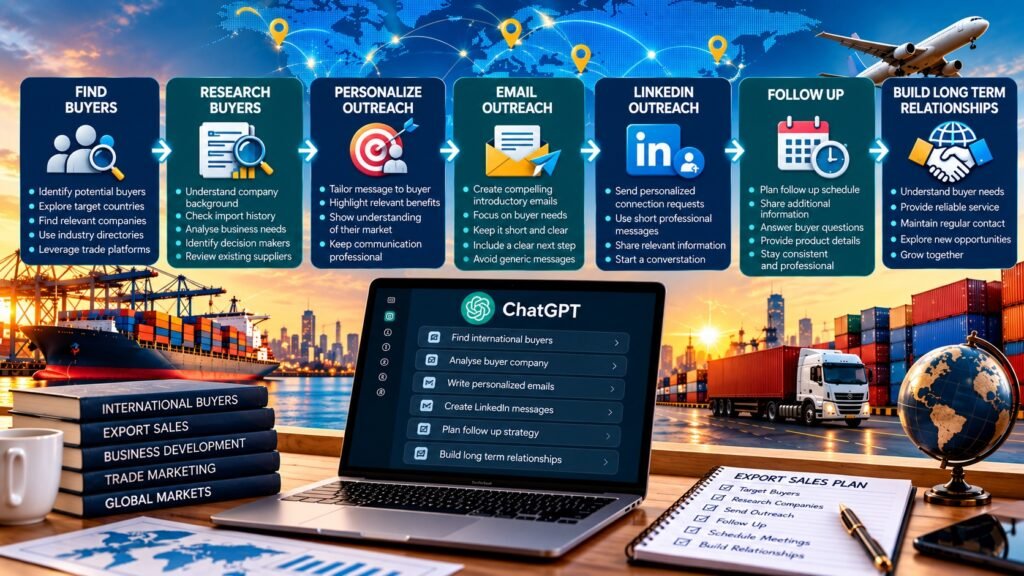
ChatGPT in Import Export Business can help you organize this research and create a structured buyer identification process.
Instead of simply asking:
“Find buyers for my product.”
give ChatGPT information about your product, target countries, customer type and preferred buyer profile.
Example Prompt
Act as an international business development consultant. Create a buyer profile for [Product]. Identify the types of companies most likely to import this product in [Target Countries]. Include industry, company size, typical purchasing requirements, potential decision makers and reasons they may be interested in the product.
You can then use the output to develop a buyer research checklist.
For example:
Create a research framework for identifying potential international buyers of [Product] in [Country]. Include company type, industry, estimated purchasing requirements, distribution model, existing suppliers and information that should be verified before contacting the company.
This can help you move from a broad search for customers to a more focused approach based on the type of buyer you actually want.
The book includes dedicated sections covering buyer identification, buyer research, export sales and outreach, and LinkedIn based business development.
However, AI generated buyer information should always be verified. Company websites, business registrations, contact details, purchasing activity and other relevant information should be checked independently before investing significant time in a prospect.
6. ChatGPT in Import Export Business for Export Sales and Outreach
Once potential buyers have been identified, the next challenge is starting a meaningful conversation.
A generic sales email often gets ignored because it focuses too much on the seller and not enough on the buyer’s needs.
ChatGPT in Import Export Business can help you prepare more relevant sales communication by using information about the buyer, product and market.
For example, you can ask ChatGPT to create a personalized first contact message.
Example Prompt
Act as an international export sales professional. Write a concise introductory email to a potential buyer of [Product]. The buyer is [Company Type] based in [Country]. Highlight the product’s relevant benefits, our export capability and the reason for contacting this company. Keep the tone professional and avoid making unsupported claims.
You can also create different versions for different channels.
For example:
Create three versions of an export sales message for [Product]. Write one professional email, one short LinkedIn message and one WhatsApp business message. Keep each version concise and focused on starting a conversation rather than making an aggressive sales pitch.
Another useful approach is to ask ChatGPT to personalize your outreach based on information you have already researched about the company.
This allows you to move away from mass messaging and toward more relevant communication.
The goal is not to let AI send messages without review. The goal is to use AI to create a strong first draft that you can check, personalize and adapt before sending.
Good international sales still depend on credibility, product knowledge, relationship building, follow up and understanding the buyer’s requirements.
7. ChatGPT in Import Export Business for Trade Documentation
International trade depends heavily on accurate documentation. A shipment can involve commercial invoices, packing lists, transport documents, certificates, customs documentation and other records.
Even a small inconsistency between documents can create delays, disputes or additional work.
ChatGPT in Import Export Business can help businesses organize their documentation process by creating checklists, reviewing information and identifying areas that need attention.
For example, you can ask:
Example Prompt
Act as an international trade documentation specialist. Create a complete documentation checklist for exporting [Product] from [Country] to [Country]. Include the documents that should be prepared, reviewed and verified before shipment.
You can also use ChatGPT to review the consistency of different documents.
Example Prompt
Create a verification checklist for comparing a commercial invoice, packing list and shipping document for an international shipment. Identify the information that should be consistent across all documents and highlight common areas where errors can occur.
This can be useful for improving internal controls and reducing avoidable documentation errors.
You can also ask ChatGPT to create a responsibility matrix showing who should prepare, review and approve each document.
However, documentation requirements can vary depending on the product, countries involved, transaction structure and applicable regulations. AI should therefore be used to support preparation and organization, while actual requirements should be verified with the relevant authorities, customs professionals, banks or other qualified professionals.
Your book specifically includes prompts for trade document checklists, documentation workflows, commercial invoices, packing lists, bills of lading, certificates, customs documentation and documentary compliance.
8. ChatGPT in Import Export Business for Logistics and Shipping
Once you have identified the right product, supplier, and buyer, the next challenge is moving the goods efficiently from one country to another.
Logistics affects much more than delivery time. Freight costs, shipment planning, documentation, transportation arrangements, delays, and payment timing can all influence the profitability of an international trade transaction.
ChatGPT can help importers and exporters organize logistics information, compare shipping options, prepare checklists, and identify questions that should be discussed with freight forwarders and logistics providers.
Compare Shipping Options
Different shipments may require different transportation solutions depending on the product, quantity, destination, urgency, and available budget.
You can use ChatGPT to structure a comparison before discussing the options with your logistics provider.
Example prompt:
“I need to export [product] from [origin country] to [destination country]. Compare the available shipping options based on estimated transit time, freight cost considerations, reliability, documentation requirements, and suitability for my shipment. Present the comparison in a table and identify the key questions I should ask my freight forwarder.”
This can help you understand the factors that need to be considered before selecting a shipping method.
Prepare a Logistics Checklist
International shipments involve multiple activities and stakeholders. Missing an important step can create delays or additional costs.
You can ask ChatGPT to create a shipment checklist covering areas such as:
- Shipment planning
- Product and packaging information
- Required documents
- Freight arrangements
- Customs coordination
- Insurance considerations
- Shipment tracking
- Delivery arrangements
- Payment and follow up
Example prompt:
“Create a complete logistics checklist for exporting [product] from [country] to [destination]. Include activities before shipment, documentation, freight coordination, customs requirements, shipment tracking, delivery, and post shipment follow up. Present it as a step by step checklist.”
Work with Freight Forwarders
ChatGPT can also help you prepare questions before selecting or working with a freight forwarder.
For example, you can ask:
“Create a freight forwarder evaluation checklist for an international shipment. Include experience, service coverage, transit time, communication, documentation support, shipment tracking, pricing transparency, problem resolution, and references.”
The objective is not simply to find the cheapest logistics provider. A reliable logistics partner can be important for maintaining delivery schedules, managing documentation, and resolving problems when they arise.
Use ChatGPT to Organize Shipment Information
For larger shipments, you can provide relevant information such as product quantities, carton dimensions, weight, destination, required delivery date, and other shipment details.
ChatGPT can help organize this information into a structured logistics plan and highlight areas that require further investigation.
However, shipping costs, transit times, customs requirements, freight rates, and carrier availability can change. Important logistics information should therefore be verified with the relevant freight forwarder, carrier, customs authority, or other appropriate professional before making a commercial commitment.
The goal of using ChatGPT in Import Export Business for logistics is not to replace your freight forwarder. It is to help you prepare better, organize information, compare alternatives, and ask better questions before the shipment moves.
9. ChatGPT in Import Export Business for Trade Finance and Payment Security
A profitable international trade transaction can still create financial pressure if cash is tied up in inventory, customers take longer to pay, or financing costs become too high.
Payment security is another important consideration. Exporters may face buyer default, payment delays, currency movements and other financial risks.
ChatGPT in Import Export Business can help you organize financial analysis, compare trade finance alternatives and identify questions that should be discussed with your bank or finance professional.
For example, you can use this prompt:
Example Prompt
Act as a trade finance consultant. Explain the main trade finance options available for an importer or exporter handling a transaction of [Amount] between [Country A] and [Country B]. Compare letters of credit, documentary collections, trade loans, working capital finance and other relevant options. Explain the purpose, advantages, limitations, risks and key considerations for each.
You can also use ChatGPT to examine working capital requirements:
Example Prompt
Analyze the working capital requirements of an import export transaction involving [Product]. Consider supplier payment terms, inventory holding period, shipping time, customer credit period and expected collection date. Identify potential cash flow pressure points and suggest questions to discuss with a finance provider.
Currency risk can also be included in the analysis.
For example:
Analyze the potential impact of exchange rate movements on an export transaction of [Amount] in [Currency]. Identify the main currency exposure points and explain possible approaches for managing the risk.
The objective is not to let AI make a financing decision for you. It is to help you understand the alternatives, organize the financial information and prepare better questions for your bank, finance team or professional adviser.
Your book covers letters of credit, trade finance, export credit insurance, currency risk and payment security as dedicated areas of international trade finance.
10. ChatGPT in Import Export Business for Operations and Business Growth
Getting the first transaction right is important. Building a sustainable international business requires something more.
As the business grows, the number of suppliers, customers, products, shipments, employees and decisions increases. Without proper systems, this additional complexity can create operational problems.
ChatGPT in Import Export Business can help businesses organize processes, create Standard Operating Procedures, develop performance measures and explore growth opportunities.
For example, you can ask ChatGPT to create an operating procedure:
Example Prompt
Act as a business process consultant. Create a Standard Operating Procedure for managing an export order from customer confirmation through production, documentation, shipment, delivery and payment collection. Identify the responsible person, key controls, required documents and important checkpoints at each stage.
You can also use ChatGPT to develop performance indicators:
Create a management dashboard framework for an import export business. Include sales, gross margin, order conversion, supplier performance, inventory, shipment performance, receivables, cash flow and customer service indicators.
When the business is ready to expand, you can ask ChatGPT to structure a growth analysis:
Create a business growth framework for an international trading company planning to enter two additional countries. Evaluate product opportunities, market entry requirements, supplier capacity, logistics, working capital, customer acquisition and operational risks.
These applications can help turn scattered business information into structured workflows and management systems.
Your book’s Business Operations and Growth section focuses on process management, customer service, team coordination, performance measurement, workflow optimization, operational controls and sustainable growth.
The key is to use AI as a support system for planning and execution. Leadership, commercial judgment, relationships and accountability still remain essential.
How to Get Better Results from ChatGPT in Import Export Business
Using ChatGPT is easy. Getting consistently useful results requires a little more thought.
The difference often comes down to how you structure your prompt.
A simple question such as:
“How can I find buyers?”
may produce a broad answer.
A more structured question gives ChatGPT information about your situation, objective and expected result.
For example:
I export packaged food products from India and want to identify wholesale distributors in Saudi Arabia. Create a buyer research framework covering buyer profile, sourcing channels, company size, purchasing requirements and outreach strategy. Present the result as a table.
The second prompt gives ChatGPT much more information to work with.
Your ChatGPT in Import Export Business workflow can become more effective when you follow five simple principles.
1. Provide Context
Tell ChatGPT about your product, country, target market, customer type, business model and objective.
The more relevant context you provide, the more useful the response is likely to be.
2. Define the Objective
Be clear about what you want to achieve.
Are you researching a market?
Comparing suppliers?
Finding buyers?
Preparing a shipment?
Evaluating financing options?
Creating an operating procedure?
A clear objective helps keep the response focused.
3. Specify the Output
Tell ChatGPT how you want the information presented.
You can request:
- A comparison table
- A checklist
- A framework
- A step by step process
- An action plan
- A risk assessment
- A business report
- An email or sales message
4. Use Follow Up Questions
Do not assume the first response is the final answer.
Ask ChatGPT to explain, compare, challenge assumptions, provide examples or improve the original response.
The book emphasizes that the real value of AI often comes from multiple rounds of interaction rather than treating ChatGPT like a simple search engine.
5. Verify Before Acting
This is particularly important in international trade.
Before making decisions involving suppliers, buyers, contracts, customs, regulations, logistics, financing or payments, verify critical information through appropriate sources and qualified professionals.
AI can support your thinking, but it should not replace professional judgment.
The book specifically recommends customizing prompts, providing context, using follow up prompts, verifying critical information and building a personal prompt library.
A Simple Formula for Better Prompts
A useful framework is:
Context + Objective + Instructions + Output Format + Constraints
For example:
I am an exporter of [Product] from [Country]. I want to enter [Target Market]. Analyze the market opportunity, competition, regulatory considerations and logistics requirements. Present the findings in a comparison table. Focus on opportunities suitable for a business with a budget of [Amount].
This is much more useful than simply asking:
“Is this a good market?”
The key lesson is simple:
Better questions often lead to better answers.
And in ChatGPT in Import Export Business, better answers can help you research faster, organize information more effectively and prepare for better business decisions.
The underlying framework in your book is Context + Objective + Instructions + Output Format + Constraints.
From Individual Prompts to a Complete Import Export AI System
Using ChatGPT for individual tasks can save time. But the bigger opportunity is to connect those individual tasks into a system that supports the entire import export business.
A successful import export business depends on many connected activities:
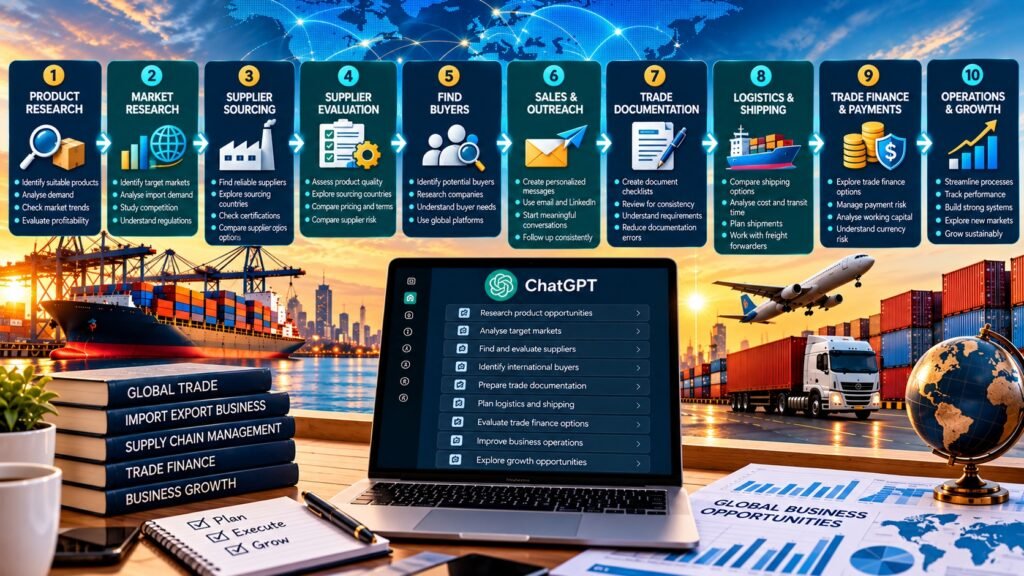
Product research → Market research → Supplier sourcing → Supplier evaluation → Buyer development → Sales communication → Documentation → Logistics → Finance → Operations → Growth
Instead of treating each activity as a separate task, businesses can use ChatGPT as a support system across these functions.
Your goal is not to let AI run the business. The goal is to build a smarter and more efficient trading company where human judgment remains at the center and AI supports research, planning, communication, documentation, and decision making. This is the approach explained in Start and Grow an Import Export Business with ChatGPT.
Build Repeatable Workflows
For example, imagine you want to enter a new international market.
Instead of asking ChatGPT only one question such as:
“How can I sell my product in Saudi Arabia?”
you can develop a complete workflow.
Step 1: Research the product
Ask ChatGPT to examine demand, competition, profitability, sourcing considerations, and potential challenges.
Step 2: Research the market
Compare customer segments, competition, market conditions, distribution channels, and potential barriers.
Step 3: Research suppliers
Develop supplier criteria and identify the information that needs to be verified before approaching or selecting suppliers.
Step 4: Develop potential buyers
Create buyer profiles based on product type, market, customer segment, and purchasing requirements.
Step 5: Prepare sales communication
Use ChatGPT to develop customized outreach emails, sales messages, proposals, and follow up communications.
Step 6: Organize documentation
Create document checklists and review requirements before the transaction moves forward.
Step 7: Plan logistics
Organize shipment information, compare logistics considerations, and prepare questions for freight forwarders.
Step 8: Review financial and payment considerations
Examine working capital requirements, payment terms, financing considerations, and potential risks.
Step 9: Build operating procedures
Document recurring activities so that the business does not depend entirely on the founder’s personal knowledge.
Step 10: Improve and scale
Use performance information to identify operational problems, improve processes, and plan future growth.
This approach turns ChatGPT from a tool used occasionally into a business support system that can assist across multiple functions of an import export company.
From Tasks to Systems
The difference between using AI occasionally and building an AI enabled trading company is the way the technology is integrated into business processes.
An individual prompt helps with an individual task.
A workflow connects several tasks.
A system connects those workflows and creates a repeatable way of operating.
For example:
Research system
Market research → competitor analysis → opportunity evaluation
Supplier system
Supplier research → evaluation → communication → performance monitoring
Buyer development system
Buyer research → qualification → outreach → follow up → relationship management
Operations system
Order management → documentation → logistics → payment tracking → reporting
The book explains that sustainable growth depends on processes that can be repeated, improved, and scaled over time. It also emphasizes that the objective is not to replace people, but to create a smarter and more efficient trading company.
Standardize Before You Automate
One important principle is to improve the process before trying to automate it.
If a business process is unclear, automating it can simply make the existing problems happen faster.
Start by documenting:
- What needs to be done
- Who is responsible
- What information is required
- What decisions need to be made
- What documents are required
- What checks must be completed
- What happens when something goes wrong
ChatGPT can then help create SOPs, checklists, process maps, training materials, and workflow documentation.
The book specifically discusses using AI to support SOP development, process improvement, employee training, workflow design, and knowledge management.
A Simple Framework for Building Your AI System
You can think about the process in five stages:
1. Identify
Find repetitive, information intensive, or time consuming activities.
2. Standardize
Create a clear process for how the activity should be performed.
3. Support
Use ChatGPT to assist with research, communication, documentation, analysis, or planning.
4. Review
Check the quality of the output and verify important information.
5. Improve
Refine the workflow based on experience and business results.
This creates a continuous improvement cycle rather than simply adding another technology tool to the business.
The Bigger Opportunity
The real opportunity with ChatGPT in Import Export Business is not simply asking better questions.
It is learning how to integrate AI into the way an import export business researches opportunities, communicates with suppliers and buyers, manages information, documents processes, and makes decisions.
The objective is to build a business that can operate with greater speed, consistency, visibility, and scalability, while keeping people responsible for judgment, relationships, verification, and important commercial decisions.
That is what makes ChatGPT in Import Export Business more than a collection of individual uses. It can become part of a broader operating system for a modern trading company.
Putting ChatGPT to Work in Your Import Export Business
Knowing what ChatGPT can do is only the beginning. The real value comes from applying it consistently to the activities that matter most in your business.
Whether you are researching a new product, evaluating a market, looking for suppliers, developing international buyers, preparing sales communication, organizing documentation, planning logistics, reviewing financial considerations, or improving daily operations, ChatGPT in Import Export Business can help you structure information and work through each stage more efficiently.
The key is to start with a real business requirement.
Instead of asking ChatGPT random questions, identify a specific task that takes time or requires significant research. Then provide the relevant context, explain what you are trying to achieve, and ask for the output in a useful format.
For example, an exporter entering a new market could use ChatGPT to structure the process from market research through buyer development and sales outreach.
A business owner could use it to create an SOP for handling export orders.
A sourcing professional could use it to develop a supplier evaluation framework.
A trading company could use it to organize recurring reporting, customer communication, documentation checks, and operational workflows.
The objective is not to use AI for everything.
The objective is to identify where ChatGPT in Import Export Business can genuinely improve the way you work.
Start Small and Build Gradually
You do not need to transform your entire business overnight.
Start with one or two processes.
Test how ChatGPT performs.
Review the results.
Improve your instructions.
Create a repeatable workflow.
Then gradually expand its use into other areas of the business.
Over time, individual improvements can become connected systems that support research, communication, operations, decision making, and growth.
Most importantly, always verify important information before acting. Supplier information, buyer information, customs requirements, regulations, contracts, financial decisions, payment arrangements, and other commercially important matters should not be accepted simply because an AI tool provides an answer.
ChatGPT should help you work better, not remove the need for business judgment.
The Practical Takeaway
The future of international trade will not be about choosing between people and technology.
It will be about using technology to help people become more informed, productive, responsive, and efficient.
That is where ChatGPT in Import Export Business can become valuable.
Use it to research.
Use it to organize.
Use it to compare.
Use it to communicate.
Use it to build processes.
Use it to identify questions you need to investigate further.
And then apply your own experience, judgment, relationships, and commercial understanding before making important decisions.
The technology is the tool.
The business decision is still yours.
Want to Explore This Further?
If you want to go beyond individual applications and learn how ChatGPT can support the wider import export business journey, my book, Start and Grow an Import Export Business with ChatGPT, takes a deeper look at the subject.
It covers product and market research, supplier sourcing and evaluation, international buyers, export sales, trade documentation, logistics, trade finance, risk management, operations, systems, and business growth.
You can learn more about the book, its contents, and available formats on my website:
Start and Grow an Import Export Business with ChatGPT
If you prefer to purchase directly, the book is also available on Amazon:
Buy Start and Grow an Import Export Business with ChatGPT on Amazon
The book is designed to help readers understand how ChatGPT in Import Export Business can be applied as a practical business support tool while keeping human judgment, verification, and commercial experience at the center.
Final Thoughts
ChatGPT is changing how businesses research information, communicate, plan, and manage everyday work. For importers and exporters, these capabilities can be particularly useful because international trade involves information, coordination, documentation, communication, and decisions across multiple markets.
The important thing is not simply to use more AI.
It is to use ChatGPT in Import Export Business where it can create practical value.
Start with a real business problem. Give ChatGPT enough context. Ask clear questions. Review the output. Verify important information. Then turn useful ideas into processes that can be repeated and improved.
Whether you are researching your first product, looking for an international buyer, evaluating a supplier, planning a shipment, or building systems for a growing trading company, AI can become a useful part of your workflow.
But technology remains a tool.
Good decisions still require good information, sound judgment, verification, relationships, and execution.
The businesses that use these capabilities thoughtfully can spend less time on repetitive work and more time focusing on customers, opportunities, relationships, and growth.
The opportunity is not simply to use ChatGPT.
The opportunity is to use it intelligently to build a better import export business.