
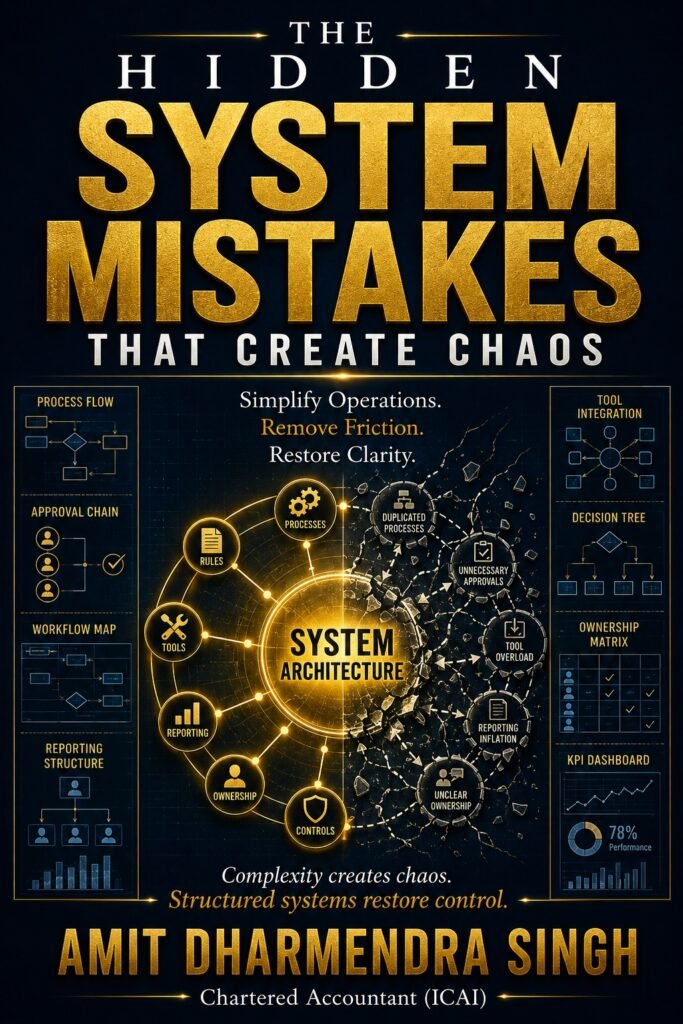
Simplify Operations. Remove Friction. Restore Clarity.
The Hidden System Mistakes That Create Chaos examines how systems, tools, processes, rules, and approvals gradually accumulate inside organizations and create operational friction. It reveals why complexity slows execution, increases confusion, and drains organizational energy while providing practical frameworks to simplify operations, remove friction, and restore clarity without weakening control.
Available Languages & Formats
🇬🇧 English
✅ Kindle
✅ Paperback
✅ Hardcover
✅ Audiobook
Buy on Amazon
Select your preferred Amazon marketplace below. Availability varies by language and format.
If your country is not listed below, you can purchase from Amazon.com (US) or your nearest available Amazon marketplace. Kindle editions can usually be delivered worldwide, subject to Amazon regional availability.
🇬🇧 English
📖 Buy the Book on Amazon – US | UK | DE | FR | ES | IT | NL | JP BR | CA | MX | AU | IN
🎧 Listen on Audible – Audible
What You’ll Learn
The Hidden System Mistakes That Create Chaos examines how unmanaged complexity gradually disrupts clarity, speed, and coordination inside organizations. It explores why systems, tools, processes, rules, approvals, and reporting structures become heavy over time and provides practical frameworks for restoring operational clarity.
In this book, you will learn how to:
- Recognize how complexity accumulates inside organizations
- Identify unnecessary system additions and structural overload
- Reduce tool overload and platform confusion
- Simplify processes that have expanded across departments
- Address rule inconsistency and policy drift
- Remove approval layers that add little value
- Reduce reporting inflation and information noise
- Replace temporary structural patches with deliberate redesign
- Identify coordination friction and slow execution cycles
- Reduce cognitive overload inside teams
- Clarify ownership across workflows and systems
- Detect redundant work and hidden duplication
- Reduce the energy drain caused by excessive system maintenance
- Address decision delays created by structural ambiguity
- Apply system simplification and tool rationalization frameworks
- Build process hygiene and clear rule hierarchies
- Conduct structural clarity audits
- Maintain long term system discipline and operational clarity
Who Should Read This Book?
This book is designed for leaders and professionals responsible for designing, managing, and improving organizational systems, processes, and operations.
It is ideal for:
- Business owners managing growing organizational complexity
- CEOs and senior executives responsible for organizational design
- COOs and operations leaders seeking to reduce friction
- Managers responsible for processes, workflows, and coordination
- Transformation and process improvement professionals
- Leaders dealing with excessive approvals and reporting requirements
- Organizations struggling with duplicated systems and tools
- Teams experiencing slow execution and structural confusion
- Professionals responsible for improving operational efficiency
- Anyone seeking to simplify systems without weakening control
Key Topics Covered
The Hidden System Mistakes That Create Chaos explores how structural accumulation creates operational friction and how disciplined design can restore clarity and execution speed.
Topics covered include:
- System accumulation without review
- Tool overload and platform confusion
- Process sprawl across departments
- Rule inconsistency and policy drift
- Layered approvals that add no value
- Reporting inflation and information noise
- Structural patching instead of redesign
- Coordination friction
- Slow execution cycles
- Cognitive overload inside teams
- Organizational confusion about ownership
- Redundant work and hidden duplication
- Energy drain from system maintenance
- Decision delays caused by structural ambiguity
- System simplification frameworks
- Tool rationalization
- Process hygiene discipline
- Rule hierarchy structures
- Structural clarity audits
- Clarity maintenance and system discipline
Why I Wrote This Book
I wrote The Hidden System Mistakes That Create Chaos because complexity is often mistaken for sophistication.
Over time, I have observed that organizations rarely become complicated because of one major mistake. Complexity usually accumulates gradually. Systems are added, tools multiply, processes expand, rules drift, and approvals increase. Each addition may appear reasonable, but together they can create structures that slow execution and weaken clarity.
The strongest organizations are not necessarily those with the fewest systems. They are the ones with intentional systems, proportionate controls, and structures that support execution rather than obstruct it.
I wanted to provide leaders with a practical lens for examining accumulated complexity and questioning whether existing structures still serve their original purpose. It is easy to add another process or temporary patch. It requires greater discipline to remove, redesign, and simplify.
This book is not a call for minimalism. It is a call for intentional design.
Clarity is not accidental. It is designed.
Inside the Book
The Hidden System Mistakes That Create Chaos examines how operational complexity quietly accumulates inside organizations and gradually disrupts clarity, speed, coordination, and execution. It explores how systems, tools, processes, rules, approvals, and reporting structures can grow beyond their original purpose and create unnecessary friction.
The book is structured in three parts, moving from identifying how complexity creeps into organizations to understanding its operational impact and applying practical frameworks that restore clarity and disciplined structure.
Chapter 1: System Accumulation Without Review
Understand how organizations gradually accumulate systems and structures without regularly reviewing whether they still serve a useful purpose.
Chapter 2: Tool Overload and Platform Confusion
Explore how overlapping tools and platforms create confusion, duplicate work, and fragmented ways of operating.
Chapter 3: Process Sprawl Across Departments
Examine how processes expand independently across departments and create unnecessary complexity and coordination problems.
Chapter 4: Rule Inconsistency and Policy Drift
Learn how inconsistent rules and evolving policies create uncertainty about expectations and acceptable ways of working.
Chapter 5: Layered Approvals That Add No Value
Discover how excessive approval layers slow execution without meaningfully improving control or decision quality.
Chapter 6: Reporting Inflation and Information Noise
Understand how increasing reports and information demands can reduce visibility rather than improve it.
Chapter 7: Structural Patching Instead of Redesign
Explore why temporary fixes often become permanent structures and how repeated patching creates deeper complexity.
Chapter 8: Coordination Friction
Examine how excessive structure makes communication and coordination across teams more difficult.
Chapter 9: Slow Execution Cycles
Understand how accumulated processes, approvals, and systems gradually extend the time required to complete work.
Chapter 10: Cognitive Overload Inside Teams
Learn how employees lose clarity and energy when they must navigate too many systems, rules, and processes.
Chapter 11: Organizational Confusion About Ownership
Explore how structural complexity can blur responsibilities and create uncertainty about who owns decisions and outcomes.
Chapter 12: Redundant Work and Hidden Duplication
Discover how overlapping systems and processes cause the same work to be repeated across teams.
Chapter 13: Energy Drain from System Maintenance
Understand how organizations gradually shift energy away from productive work toward maintaining unnecessary structures.
Chapter 14: Decision Delays Caused by Structural Ambiguity
Examine how unclear systems and overlapping structures create hesitation and slow organizational decisions.
Chapter 15: The System Simplification Framework
Learn a practical approach for examining existing structures and simplifying them without weakening necessary control.
Chapter 16: Tool Rationalization Model
Explore how organizations can evaluate, consolidate, and manage tools more intentionally.
Chapter 17: Process Hygiene Discipline
Understand how regular review and disciplined maintenance can prevent processes from becoming unnecessarily complex.
Chapter 18: Rule Hierarchy Structure
Learn how clear rule structures and priorities can reduce inconsistency and operational confusion.
Chapter 19: Structural Clarity Audit
Discover how to systematically examine systems, processes, tools, and controls to identify unnecessary complexity.
Chapter 20: Clarity Maintenance and System Discipline
Bring the ideas together through practices that help organizations maintain clarity and prevent complexity from accumulating again.
Frequently Asked Questions
The Hidden System Mistakes That Create Chaos examines how operational complexity develops gradually through accumulated systems, tools, processes, rules, approvals, and reporting requirements. It explains the consequences of unmanaged structure and provides practical frameworks for simplifying operations without weakening control.
1. What is The Hidden System Mistakes That Create Chaos about?
The Hidden System Mistakes That Create Chaos book examines how organizations gradually become complex through accumulated systems and structures. It explains how this complexity creates coordination friction, slow execution, cognitive overload, duplication, unclear ownership, and decision delays, while offering practical ways to restore operational clarity.
2. Is this book about eliminating systems and processes?
No. The Hidden System Mistakes That Create Chaos book does not argue against structure. Strong organizations require systems and controls. The focus is on creating intentional, proportionate structures and removing unnecessary complexity that no longer improves decision quality or execution speed.
3. Who should read this book?
The Hidden System Mistakes That Create Chaos book is designed for business owners, CEOs, senior executives, operations leaders, managers, and professionals responsible for improving organizational systems, processes, coordination, and execution.
4. What kind of problems does the book address?
It addresses issues such as tool overload, process sprawl, inconsistent rules, excessive approvals, reporting noise, structural duplication, unclear ownership, slow execution, and decision delays caused by unnecessary complexity.
5. Does the book provide practical frameworks?
Yes. The final part introduces practical frameworks including the System Simplification Framework, Tool Rationalization Model, Process Hygiene Discipline, Rule Hierarchy Structure, Structural Clarity Audit, and Clarity Maintenance practices.
6. Is the book theoretical or practical?
The Hidden System Mistakes That Create Chaos book focuses on practical operational clarity rather than abstract theory. It is designed to help leaders identify accumulated complexity and apply structured approaches to simplify operations.
7. Can organizations simplify systems without losing control?
Yes. A central idea of The Hidden System Mistakes That Create Chaos book is that simplification does not mean removing necessary controls. The objective is to restore functional structure by ensuring that systems support clarity, decision quality, and execution rather than creating unnecessary friction.
About the Author
Amit Dharmendra Singh is a Chartered Accountant (ICAI), DISA (ICAI), Finance Executive, Author, and AI in Finance Advocate with more than 23 years of international leadership experience across India, Thailand, and Saudi Arabia. His work focuses on corporate finance, cash flow management, working capital optimization, business transformation, and artificial intelligence in finance.
Through his books, Amit shares practical frameworks and real world insights that help finance professionals, business leaders, and entrepreneurs make better financial decisions and build stronger organizations.
Related Books
📘 The Hidden Decision Mistakes That Slow Businesses
Learn how unclear ownership, repeated discussions, and delayed decisions quietly weaken momentum and discover practical systems to restore speed, clarity, and execution.
📘 The Hidden Growth Mistakes That Break Companies
Learn how rapid growth can create hidden structural risks and discover practical systems to scale with greater stability and discipline.
📘 The Hidden Execution Mistakes That Waste Effort
Learn how misalignment, unclear priorities, and scattered effort weaken execution and discover ways to restore focus and measurable results.
📘 The Hidden Leadership Mistakes That Destabilize Organizations
Learn how leadership patterns can create instability and discover practical systems to strengthen consistency, decision quality, and organizational discipline.
📘 The Hidden Strategy Mistakes That Blur Direction
Learn how unclear priorities and weak strategic discipline fragment execution and discover frameworks to sharpen focus and direction.
📘 The Hidden Culture Mistakes That Erode Performance
Learn how everyday behaviors can weaken accountability and standards and discover systems to build a stronger and more disciplined culture.
Continue Your Learning
Continue your finance leadership journey with more books, articles, and resources.
Explore More
📚 Explore My Books
Discover the complete collection of books on finance, leadership, artificial intelligence, business strategy, and international trade.
📝 Read the Blog
Explore practical articles, insights, and real world perspectives on corporate finance, cash flow, working capital, AI, and business transformation.
👤 About the Author
Learn more about Amit Dharmendra Singh, his professional journey, and the experience behind every book.
📩 Contact
Have a question, feedback, or would like to connect? Get in touch through the contact page.
→ Contact