
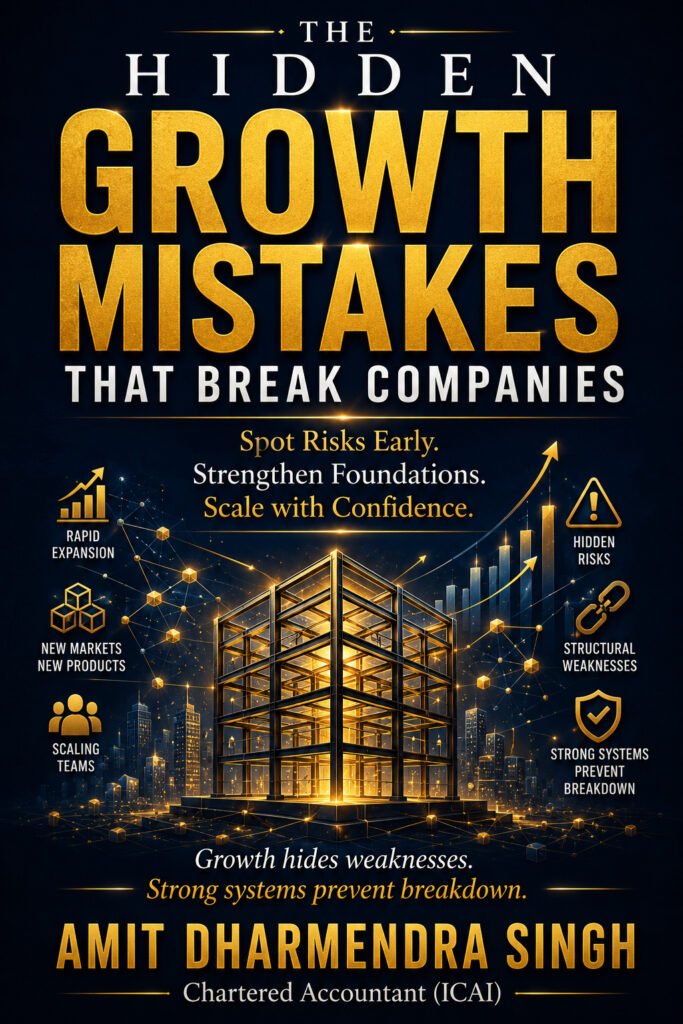
Spot Risks Early. Strengthen Foundations. Scale with Confidence.
The Hidden Growth Mistakes That Break Companies explores how rapid growth can quietly create structural risks that weaken stability, performance, and resilience. It helps business leaders identify hidden warning signs, strengthen foundations, and build practical systems for sustainable growth.
Available Languages & Formats
🇬🇧 English
✅ Kindle
✅ Paperback
✅ Hardcover
✅ Audiobook
Buy on Amazon
Select your preferred Amazon marketplace below. Availability varies by language and format.
If your country is not listed below, you can purchase from Amazon.com (US) or your nearest available Amazon marketplace. Kindle editions can usually be delivered worldwide, subject to Amazon regional availability.
🇬🇧 English
📖 Buy the Book on Amazon – US | UK | DE | FR | ES | IT | NL | JP BR | CA | MX | AU | IN
🎧 Listen on Audible – Audible
What You’ll Learn
The Hidden Growth Mistakes That Break Companies examines why rapid growth can create hidden structural pressure even when revenue, demand, and market opportunity appear strong.
In this book, you will learn how to:
- Recognise when growth is creating hidden structural fragility
- Distinguish healthy expansion from growth that only looks successful
- Identify why hiring before strengthening structure can multiply confusion
- Understand how complexity can grow faster than organizational capacity
- Recognise the limits of expansion and absorption capacity
- Spot early warning signs before structural weaknesses become major problems
- Understand how growth can create operational fragility and organizational fatigue
- Prevent leadership overstretch and cultural dilution during expansion
- Apply growth filters before committing resources to new opportunities
- Test structural readiness before scaling further
- Build disciplined hiring and controlled expansion systems
- Create sustainable scaling rules and growth operating rhythms
- Strengthen organizational resilience before the next phase of expansion
- Apply practical leadership playbooks for scaling safely
- Build a repeatable framework for sustainable growth
Who Should Read This Book?
This book is designed for business leaders and professionals who want to grow their organizations without allowing expansion to weaken structure, stability, or long term performance.
It is ideal for:
- Founders leading rapidly growing businesses
- CEOs responsible for expansion and organizational stability
- Growth stage leaders managing increasing complexity
- Senior executives responsible for scaling operations
- Business owners preparing for significant expansion
- Operations leaders dealing with growing coordination pressure
- Leaders managing rapid increases in headcount
- Investors evaluating whether organizations are structurally ready to scale
- Expansion teams entering new markets, products, or locations
- Managers who want practical systems for disciplined and sustainable growth
Key Topics Covered
The Hidden Growth Mistakes That Break Companies explores the structural pressures that emerge when organizations expand faster than their internal foundations can support.
Topics covered include:
- Growth that looks healthy but is not Hiring before structure
- Scaling complexity faster than revenue
- Expansion without absorption capacity
- The early warning signs leaders ignore
- Operational fragility Cash strain beyond finance
- Leadership overstretch Culture dilution
- When growth turns into organizational fatigue
- The compounding effect of small structural weaknesses
- Growth filters Structural readiness tests
- Hiring discipline systems
- Controlled expansion models
- Sustainable scaling rules
- Designing a growth operating rhythm
- Building structural resilience before expansion
- Leadership playbooks for scaling safely
- A practical framework for sustainable growth
Why I Wrote This Book
I wrote The Hidden Growth Mistakes That Break Companies because growth is often treated as unquestioned evidence of success. Rising revenue, expanding teams, and new opportunities create momentum, but they can also place increasing pressure on the structure of an organization.
What works at a smaller scale does not always survive unchanged as a business grows. Informal systems begin to strain, coordination becomes heavier, leadership attention fragments, and small weaknesses can gradually become structural problems.
I wanted to examine these hidden patterns and make them easier for leaders to recognise before the damage compounds.
This book is not about slowing ambition or avoiding expansion. It is about helping organizations grow deliberately rather than reactively.
My goal is to provide practical frameworks that help leaders strengthen foundations, test readiness, manage expansion with discipline, and build organizations capable of absorbing growth without sacrificing stability.
Strong organizations do not simply grow faster. They design how they grow.
Inside the Book
The Hidden Growth Mistakes That Break Companies examines why growth can create instability when expansion moves faster than an organization’s structure, systems, and leadership capacity. The book explores the hidden risks that appear during scaling and provides practical frameworks for building stronger foundations, managing expansion with discipline, and creating sustainable growth.
Chapter 1: Growth That Looks Healthy but Is Not
Understand why rising revenue and visible momentum can hide structural fragility and learn to distinguish healthy growth from expansion that quietly weakens stability.
Chapter 2: Hiring Before Structure
Explore why adding people before clarifying roles, workflows, and accountability can multiply confusion rather than increase capacity.
Chapter 3: Scaling Complexity Faster Than Revenue
Learn how uncontrolled layers of tools, processes, and approvals create friction and why growing organizations must balance sophistication with simplicity.
Chapter 4: Expansion Without Absorption Capacity
Understand how growth can exceed an organization’s ability to integrate change and why leadership bandwidth, process maturity, and cultural cohesion determine sustainable expansion.
Chapter 5: The Early Warning Signs Leaders Ignore
Identify the subtle signals of structural strain, including communication congestion, decision hesitation, process improvisation, and growing dependence on extraordinary effort.
Chapter 6: Operational Fragility
Explore how unresolved structural weaknesses make operations increasingly vulnerable as volume, complexity, and pressure increase.
Chapter 7: Cash Strain Beyond Finance
Understand why rapid growth can create financial pressure even when revenue is increasing and how operational decisions affect liquidity and stability.
Chapter 8: Leadership Overstretch
Learn how expanding organizations can overwhelm leadership capacity and why fragmented attention weakens decision quality and organizational direction.
Chapter 9: Culture Dilution
Examine how rapid growth can weaken shared standards, expectations, and behaviors when new people and teams are not effectively integrated.
Chapter 10: When Growth Turns Into Organizational Fatigue
Discover how continuous expansion without stabilization exhausts teams and creates an organization that remains busy but gradually loses resilience.
Chapter 11: The Compounding Effect of Small Structural Weaknesses
See how seemingly minor inefficiencies and inconsistencies accumulate over time and eventually become significant organizational risks.
Chapter 12: Growth Filters
Learn practical ways to evaluate opportunities before committing resources and ensure that expansion aligns with strategic priorities and organizational capacity.
Chapter 13: Structural Readiness Tests
Explore how systematic readiness assessments can measure whether processes, leadership, training, and operations are prepared for additional scale.
Chapter 14: Hiring Discipline Systems
Learn how to separate genuine capacity needs from structural inefficiencies and make hiring decisions based on evidence rather than urgency.
Chapter 15: Controlled Expansion Models
Understand how phased expansion, pilots, feedback loops, and readiness gates can reduce risk while preserving momentum.
Chapter 16: Sustainable Scaling Rules
Discover how clear operating principles and organizational guardrails help companies preserve learning and avoid repeating the same growth mistakes.
Chapter 17: Designing a Growth Operating Rhythm
Learn how to balance periods of expansion and stabilization so growth becomes a disciplined rhythm rather than repeated cycles of acceleration and repair.
Chapter 18: Building Structural Resilience Before Expansion
Explore how organizations can strengthen systems, capacity, and adaptability before pressure exposes hidden weaknesses.
Chapter 19: Leadership Playbooks for Scaling Safely
Understand the leadership practices that create clarity, disciplined delegation, consistent priorities, and stability during periods of expansion.
Chapter 20: A Practical Framework for Sustainable Growth
Bring the ideas together through an integrated framework built around diagnosis, stabilization, filtered expansion, rhythmic scaling, and institutional learning.
Frequently Asked Questions
The Hidden Growth Mistakes That Break Companies explores why organizations can experience instability during periods of rapid expansion and how deliberate structure can turn growth into sustainable progress.
1. What is The Hidden Growth Mistakes That Break Companies about?
The book examines the structural mistakes organizations make during growth, including premature hiring, excessive complexity, expansion beyond absorption capacity, leadership overstretch, and cultural dilution. It provides practical frameworks for scaling with greater stability and resilience.
2. Is this book against rapid growth?
No. The Hidden Growth Mistakes That Break Companies book does not argue against ambition or expansion. It explains that growth becomes more sustainable when organizational structure, systems, leadership capacity, and operational discipline develop alongside increasing scale.
3. Who should read this book?
The Hidden Growth Mistakes That Break Companies book is designed for business owners, CEOs, senior leaders, managers, and professionals responsible for leading organizations through periods of growth and expansion.
4. What practical frameworks does the book provide?
The Hidden Growth Mistakes That Break Companies book introduces growth filters, structural readiness tests, hiring discipline systems, controlled expansion models, sustainable scaling rules, growth operating rhythms, structural resilience practices, and leadership playbooks.
5. What is the main message of the book?
The central message is that growth should be treated as a design challenge. Organizations become stronger when they align ambition with structure, measure readiness before expanding, and build systems capable of absorbing pressure.
6. Can the frameworks be applied to different industries?
Yes. The principles focus on organizational structure, leadership capacity, operational discipline, and scaling decisions, making them adaptable across different industries and business environments.
About the Author
Amit Dharmendra Singh is a Chartered Accountant (ICAI), DISA (ICAI), Finance Executive, Author, and AI in Finance Advocate with more than 23 years of international leadership experience across India, Thailand, and Saudi Arabia. His work focuses on corporate finance, cash flow management, working capital optimization, business transformation, and artificial intelligence in finance.
Through his books, Amit shares practical frameworks and real world insights that help finance professionals, business leaders, and entrepreneurs make better financial decisions and build stronger organizations.
Related Books
📘 The Hidden Decision Mistakes That Slow Businesses
Learn how unclear ownership, repeated discussions, and delayed decisions quietly weaken momentum and discover practical systems to restore speed, clarity, and execution.
📘 The Hidden Execution Mistakes That Waste Effort
Learn how misalignment, unclear priorities, and scattered effort weaken execution and discover ways to restore focus and measurable results.
📘 The Hidden Leadership Mistakes That Destabilize Organizations
Learn how leadership patterns can create instability and discover practical systems to strengthen consistency, decision quality, and organizational discipline.
📘 The Hidden System Mistakes That Create Chaos
Learn how process complexity and structural friction create operational inefficiencies and discover frameworks to restore clarity and simplicity.
📘 The Hidden Strategy Mistakes That Blur Direction
Learn how unclear priorities and weak strategic discipline fragment execution and discover frameworks to sharpen focus and direction.
📘 The Hidden Culture Mistakes That Erode Performance
Learn how everyday behaviors can weaken accountability and standards and discover systems to build a stronger and more disciplined culture.
Continue Your Learning
Continue your finance leadership journey with more books, articles, and resources.
Explore More
📚 Explore My Books
Discover the complete collection of books on finance, leadership, artificial intelligence, business strategy, and international trade.
📝 Read the Blog
Explore practical articles, insights, and real world perspectives on corporate finance, cash flow, working capital, AI, and business transformation.
👤 About the Author
Learn more about Amit Dharmendra Singh, his professional journey, and the experience behind every book.
📩 Contact
Have a question, feedback, or would like to connect? Get in touch through the contact page.
→ Contact