

Many business owners believe that profitability automatically means financial strength. But a business can report healthy sales and profits while still struggling to pay salaries, suppliers, loan installments, or other day to day expenses.
The reason is simple: profit and cash are not the same thing.
Cash shortages can arise when customers pay late, inventory absorbs too much working capital, expenses increase faster than collections, or rapid growth creates additional funding pressure. These problems often remain hidden until the business faces an urgent payment crisis.
Effective cash flow management requires looking beyond the bank balance and understanding how money moves through the business.
In this article, we explore 10 cash flow mistakes every business owner should avoid and practical ways to build stronger financial control and a healthier business.
These cash flow mistakes can quietly weaken even profitable businesses, creating pressure on operations, supplier payments, and future growth.
1. Confusing Profit with Cash
One of the most common financial mistakes is assuming that a profitable business automatically has enough cash.

Profit is an accounting measure based on revenue earned and expenses incurred. Cash, however, reflects the actual money available to meet immediate business obligations. A company may record strong sales and healthy profits while its bank balance remains under pressure.
For example, a business may make a large sale on credit and recognize the revenue immediately. But if the customer takes 60 or 90 days to pay, the business still needs cash to pay employees, suppliers, rent, and other operating expenses during that period.
Similarly, money tied up in inventory, unpaid customer invoices, loan repayments, and capital expenditure can create cash pressure even when the profit and loss statement looks positive.
The Better Approach
Business owners should monitor both profitability and cash flow. Reviewing the profit and loss statement alone is not enough. Regular cash flow forecasts, receivables monitoring, and working capital analysis help reveal whether profits are actually being converted into available cash.
Remember: Profit is important, but cash keeps the business operating.
2. Operating Without a Cash Flow Forecast
Many business owners manage cash based on what they see in the bank account today. If there is enough money available, they assume the business is financially comfortable. The problem is that the bank balance only shows the present situation. It does not show what is coming next.
A business may have sufficient cash at the beginning of the month but face a serious shortage a few weeks later because of salaries, supplier payments, loan installments, rent, taxes, or other major commitments. Without a clear cash flow forecast, these upcoming obligations can easily create unexpected pressure.
A cash flow forecast helps a business look ahead. It estimates expected cash inflows from customers and other sources, while also mapping expected cash outflows. This allows management to identify potential gaps before they become a crisis.
For example, a company may expect to receive SAR 500,000 from customers during the month. However, if only SAR 250,000 is likely to be collected before payroll and supplier payments are due, the business may face a temporary cash shortage despite having strong total receivables.
The purpose of forecasting is not to predict the future perfectly. It is to give management enough visibility to prepare for different scenarios and make better decisions in advance.
A practical cash flow forecast should normally include:
- Opening cash balance
- Expected customer collections
- Other expected cash inflows
- Supplier payments
- Payroll and operating expenses
- Loan and interest payments
- Taxes and statutory obligations
- Capital expenditure
- Closing projected cash balance
The most effective businesses review and update their cash flow forecasts regularly. A rolling weekly or monthly forecast gives management time to improve collections, delay nonessential spending, negotiate supplier terms, or arrange funding before the situation becomes urgent.
Cash flow problems are much easier to manage when they are visible in advance. A forecast turns cash management from a reactive activity into a proactive business strategy.
3. Allowing Customers to Pay Late
Sales do not improve cash flow until customers actually pay.
Many businesses focus heavily on increasing revenue but give far less attention to collecting money on time. As a result, invoices remain outstanding for weeks or even months, while the business continues to pay salaries, suppliers, rent, and other operating expenses.
Late customer payments create a direct strain on working capital. The longer money remains tied up in receivables, the less cash is available to operate and grow the business.
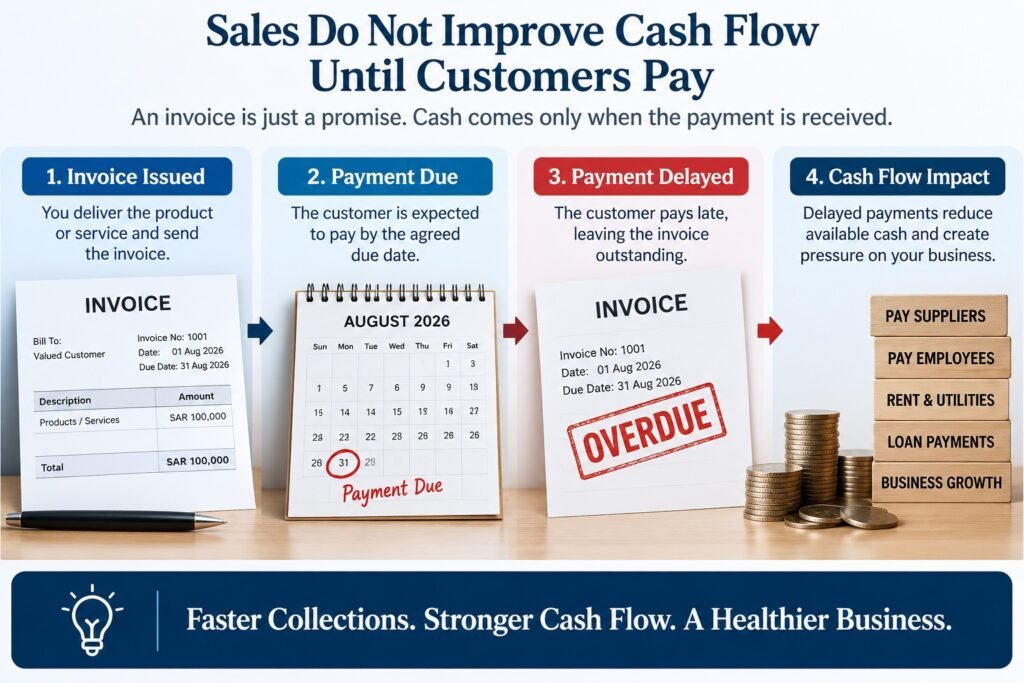
For example, a company may report monthly sales of SAR 1 million, but if a significant portion of customers consistently pays 30 to 60 days later than agreed, the business may still struggle to meet its immediate obligations.
The problem becomes even more serious when the business itself must pay suppliers before receiving money from customers. This creates a cash gap that may force the company to use overdrafts or short term borrowing simply to fund normal operations.
The Better Approach
Businesses should establish clear credit policies and actively monitor outstanding receivables. This includes setting appropriate credit terms, issuing invoices promptly, following up before due dates, and escalating overdue accounts when necessary.
Useful receivables practices include:
- Establishing clear payment terms before making a sale
- Checking customer creditworthiness where appropriate
- Sending invoices immediately and accurately
- Monitoring receivables ageing regularly
- Following up before and after payment due dates
- Resolving invoice disputes quickly
- Setting credit limits for customers
- Escalating seriously overdue accounts
A strong sales figure may look impressive on the Profit and Loss statement, but unpaid invoices cannot pay today’s expenses.
Revenue creates profit. Collections create cash.
4. Holding Too Much Inventory
Inventory is essential for many businesses, but excessive inventory can quietly consume a significant amount of cash.
Business owners often focus on avoiding stock shortages and therefore purchase more inventory than necessary. While a warehouse full of products may appear to represent business strength, it can also mean that valuable cash is sitting on shelves instead of being available for other business needs.
Slow moving or obsolete inventory creates an even greater problem. The business has already paid suppliers, but the products may take months to sell. During that period, the cash invested in inventory remains locked.
For example, a company may purchase SAR 500,000 worth of inventory to secure better supplier pricing. However, if a large portion of that inventory takes six months to sell, the immediate savings from the discount may not justify the pressure created on working capital.
The Better Approach
Businesses should regularly review inventory levels and identify slow moving, obsolete, and excess stock. Purchasing decisions should be linked to realistic sales forecasts rather than assumptions.
Useful inventory management practices include:
- Monitoring inventory turnover regularly
- Identifying slow moving and obsolete items
- Linking purchases to realistic demand forecasts
- Setting appropriate reorder levels
- Negotiating smaller or more frequent deliveries where possible
- Reviewing the cash tied up in inventory
Inventory should support sales, not silently drain the cash needed to run the business.
5. Growing Faster Than Available Cash
Growth is usually seen as a positive sign. More customers, higher sales, and larger orders can create excitement within a business. However, growth can also create serious cash flow pressure when the business does not have enough working capital to support it.
Every increase in sales may require additional investment before cash is collected. The business may need to purchase more inventory, hire additional employees, increase production, arrange logistics, or provide longer credit terms to customers.
This means a rapidly growing company can experience a cash shortage even while revenue and profits are increasing.
For example, imagine a company receives several large new customer orders. To fulfil those orders, it must immediately purchase raw materials and pay suppliers. However, the customers may only pay 60 or 90 days after delivery. The company must therefore finance the entire gap between spending cash and receiving cash.
The Better Approach
Growth should be supported by a clear working capital plan. Before accepting large orders or expanding operations, management should understand the additional cash required to support the growth.
Important questions include:
- How much additional inventory will be required?
- When must suppliers be paid?
- When will customers actually pay?
- Will additional employees or equipment be needed?
- How much working capital will be tied up?
- Is financing available if collections are delayed?
Profitable growth is valuable. Growth that consumes more cash than the business can support can quickly become dangerous.
6. Ignoring Small but Recurring Expenses
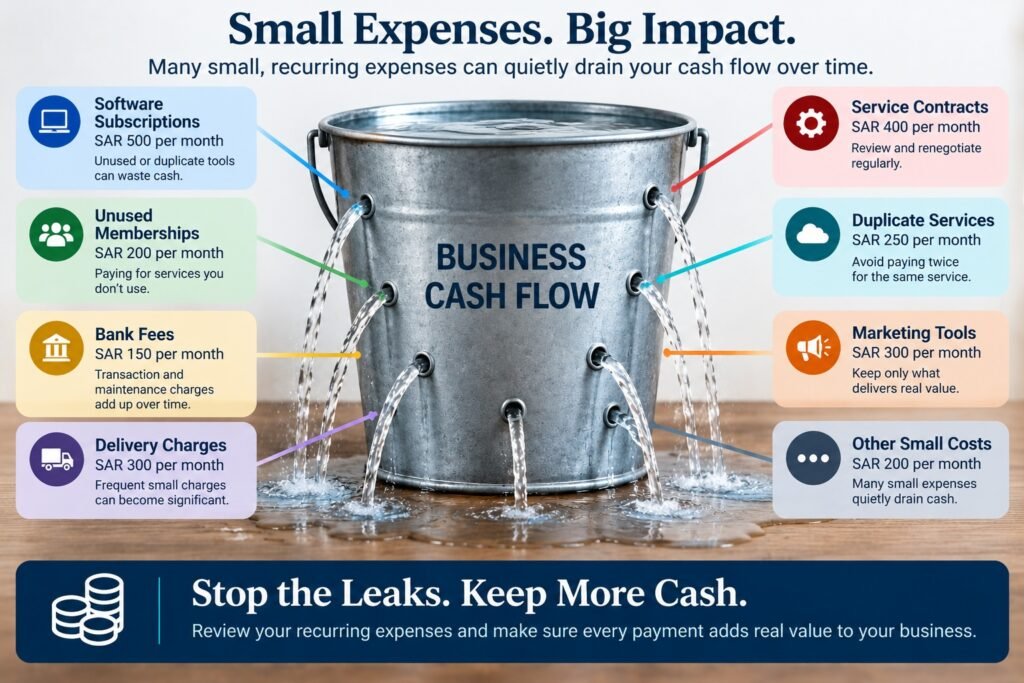
Not every cash flow problem comes from a large unexpected expense. Sometimes the biggest leakage comes from many small costs that continue month after month without receiving proper attention.
Software subscriptions, unused memberships, small service contracts, delivery charges, bank fees, duplicate subscriptions, and unnecessary administrative expenses may appear insignificant individually. However, when combined over an entire year, they can represent a substantial amount of wasted cash.
For example, a business may have ten different software subscriptions costing SAR 500 per month each. Individually, none of them appears significant. Together, they cost SAR 5,000 every month or SAR 60,000 every year. If several subscriptions are unused or duplicated, this becomes a direct and unnecessary drain on cash flow.
The Better Approach
Businesses should periodically review recurring expenses rather than focusing only on major costs. Every recurring payment should have a clear business purpose and measurable value.
Useful practices include:
- Reviewing monthly recurring expenses
- Cancelling unused subscriptions
- Identifying duplicate services
- Reviewing bank and transaction charges
- Renegotiating service contracts
- Assigning responsibility for monitoring recurring costs
Small expenses may not create an immediate crisis, but unmanaged recurring costs gradually weaken profitability and cash generation.
A healthy cash flow culture pays attention not only to major spending decisions but also to the small leaks that quietly drain cash over time.
7. Having No Cash Reserve
Many businesses operate with little or no cash reserve. As long as sales are coming in and payments are being received, this may not appear to be a problem. The risk becomes clear when an unexpected event occurs.
A major customer may delay payment. Equipment may require urgent repair. Sales may fall temporarily. A supplier may suddenly demand advance payment. Without a cash reserve, even a profitable business can quickly face financial pressure.
A cash reserve provides breathing room. It allows a business to absorb unexpected shocks without immediately relying on expensive borrowing or delaying important payments.
The appropriate reserve will vary depending on the nature and size of the business, but every business should understand its minimum cash requirement. This should include essential operating expenses, debt obligations, payroll, and other unavoidable commitments.
A strong cash position is not about keeping excessive money idle. It is about maintaining enough liquidity to protect the business when conditions do not go according to plan.
Key takeaway: A cash reserve is not unused money. It is financial protection.
8. Paying Suppliers Without Managing Payment Terms
Supplier payments are an important part of maintaining good business relationships. However, paying suppliers too early without considering agreed credit terms can put unnecessary pressure on cash flow.
For example, if a business gives customers 60 days to pay but pays suppliers immediately, it creates a significant cash gap. The business is effectively financing its customers from its own working capital.
Managing payment terms does not mean deliberately delaying suppliers or damaging relationships. It means understanding the agreed terms and aligning cash outflows with cash inflows wherever possible.
Businesses should regularly review supplier credit periods, early payment discounts, payment schedules, and opportunities to negotiate better terms. A small improvement in payment terms can have a meaningful impact on working capital.
The objective should be balance. Maintain strong supplier relationships while using the available credit period efficiently.
Key takeaway: Good cash flow management means managing when money leaves the business, not just how much is paid.
9. Using Short Term Debt to Fund Long Term Problems
Short term borrowing can be useful for temporary working capital requirements. However, problems arise when businesses use short term debt to finance long term assets or permanent cash flow gaps.
For example, using an overdraft or short term loan to purchase machinery, expand facilities, or finance a long term project can create serious repayment pressure. The loan may need to be repaid long before the investment begins generating sufficient cash.
This creates a mismatch between the life of the asset and the repayment period of the financing.
Businesses should align their funding structure with the purpose of the funding. Short term requirements should generally be supported by short term financing, while long term investments should be supported by appropriately structured long term funding.
Repeatedly refinancing short term debt can also hide deeper financial problems. If a business constantly needs new borrowing to repay old borrowing, management should investigate the underlying cash flow issue.
Key takeaway: Match the duration of your financing with the life of the asset or investment being funded.
10. Looking at Cash Only When There Is a Crisis
One of the biggest mistakes businesses make is paying attention to cash only when the bank balance becomes dangerously low.
By the time a cash crisis becomes visible, management often has limited options. The business may already have overdue receivables, excessive inventory, upcoming loan repayments, or supplier obligations that cannot easily be postponed.
Cash flow should be reviewed regularly, not only during difficult periods. Business owners and finance teams should monitor expected cash inflows, upcoming payments, working capital movements, debt obligations, and potential funding gaps.
A rolling cash flow forecast can help management identify problems weeks or months before they become critical. This creates time to improve collections, negotiate payment terms, delay nonessential expenditure, arrange financing, or adjust business plans.
The goal is to move from reacting to cash problems to managing cash proactively.
Key takeaway: Cash flow management should be a regular management discipline, not an emergency response.
Avoiding these cash flow mistakes requires consistent financial discipline, regular monitoring, and a proactive approach to managing liquidity.
Conclusion: Avoiding Cash Flow Mistakes for Long Term Business Success
Cash Flow Is Not Just an Accounting Number. It Is a Business Strategy.
Cash flow problems rarely happen because of one major mistake. More often, they develop gradually through a combination of poor decisions, delayed collections, excessive inventory, uncontrolled expenses, unsuitable financing, and a lack of forward planning.
Businesses that identify and address cash flow mistakes early are better positioned for sustainable growth and stronger financial stability.
A business can report healthy sales and profits while still struggling to pay salaries, suppliers, loan installments, or other operating expenses. This is why monitoring profit alone is not enough.
Strong businesses understand where their cash comes from, where it goes, and when it will be needed. They actively manage receivables, inventory, supplier payments, operating expenses, financing, and future cash requirements.
The most important shift is moving from reactive cash management to proactive cash management.
Do not wait for the bank balance to become a problem before reviewing your cash position. Build a regular discipline around forecasting, monitoring working capital, improving collections, and planning future funding requirements.
Cash flow is not simply an accounting number reviewed at the end of the month.
It is a business strategy that influences growth, stability, investment decisions, and the long term survival of the business.

Want to Build Stronger Cash Flow?
Effective cash flow management requires more than simply monitoring the bank balance. It requires understanding working capital, forecasting future cash needs, improving collections, managing inventory, and making better financial decisions.
If you want to develop a stronger understanding of how cash moves through a business and how financial decisions affect liquidity, explore these practical resources:
📘 Cash Flow Is Strategy, Not an Outcome
Discover why cash flow should be treated as a strategic business priority rather than simply an accounting result. Learn how better decisions around operations, growth, working capital, and financing can strengthen long term cash generation.
[Explore Cash Flow Is Strategy, Not an Outcome →]
📘 Working Capital Mastery
Understand how receivables, inventory, payables, and operating cycles influence the amount of cash tied up in your business. A practical guide to improving liquidity without relying entirely on additional borrowing.
[Explore Working Capital Mastery →]
📘 Cash Conversion Cycle Demystified
Learn how quickly your business converts investments in inventory and operations back into cash. Understand the key drivers of the cash conversion cycle and identify opportunities to release working capital.
[Explore Cash Conversion Cycle Demystified →]
📘 Money Flow for Entrepreneurs
A practical resource for entrepreneurs who want to better understand the movement of money through their business and make more confident financial decisions.
[Explore Money Flow for Entrepreneurs →]
You can also explore my complete collection of business and finance books on Amazon