
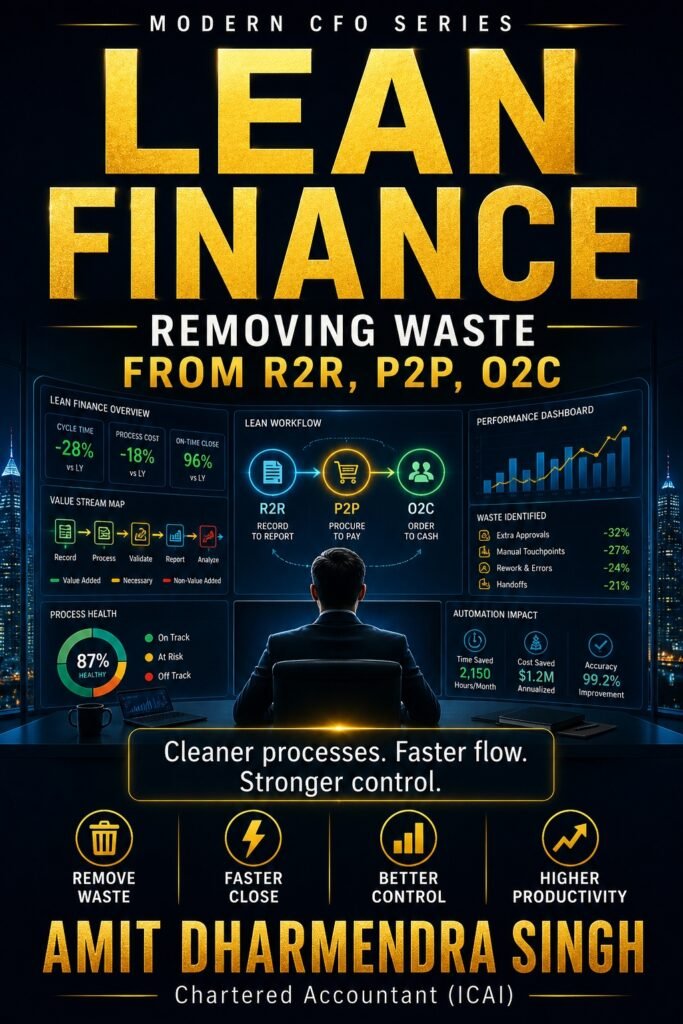
Remove waste, strengthen flow, speed up your finance
Lean Finance: Removing Waste from R2R, P2P, and O2C is a practical guide for finance leaders who want to eliminate waste, simplify processes, strengthen controls, and improve the speed and efficiency of their finance operations.
The book applies Lean principles across Record to Report, Procure to Pay, and Order to Cash, helping organisations reduce rework, improve process flow, strengthen accountability, and create more value from existing resources.
Available Languages & Formats
🇬🇧 English
✅ Kindle
✅ Paperback
✅ Hardcover
✅ Audiobook
Buy on Amazon
Select your preferred Amazon marketplace below. Availability varies by language and format.
If your country is not listed below, you can purchase from Amazon.com (US) or your nearest available Amazon marketplace. Kindle editions can usually be delivered worldwide, subject to Amazon regional availability.
🇬🇧 English
📖 Buy the Book on Amazon – US | UK | DE | FR | ES | IT | NL | JP BR | CA | MX | AU | IN
🎧 Listen on Audible – Audible
What You’ll Learn
Lean Finance is about removing unnecessary work, reducing delays, improving flow, and building finance processes that support faster and better business decisions.
In this book, you will learn how to:
- Identify waste and inefficiencies across core finance processes.
- Apply Lean principles to Record to Report, Procure to Pay, and Order to Cash.
- Reduce unnecessary activities, rework, delays, and process bottlenecks.
- Improve the speed, accuracy, and reliability of financial information.
- Streamline workflows and create more efficient finance operations.
- Strengthen process controls without adding unnecessary complexity.
- Improve collaboration between finance and other business functions.
- Use practical tools to measure process performance and identify improvement opportunities.
- Build a culture of continuous improvement within the finance function.
- Transform finance from a transaction focused function into a faster, more efficient business partner.
Who Should Read This Book?
This book is designed for finance professionals and business leaders who want to make finance processes faster, simpler, more efficient, and more valuable to the organisation.
It is ideal for:
- Chief Financial Officers and Finance Directors
- Finance Managers and Financial Controllers
- Heads of Shared Services and Finance Operations
- Finance Transformation and Process Improvement Professionals
- Accounting Managers and Senior Accountants
- Procure to Pay, Record to Report, and Order to Cash Leaders
- Business Leaders seeking to improve finance efficiency and reduce operational waste
- Consultants and Advisors supporting finance transformation
Key Topics Covered
Lean Finance focuses on applying Lean thinking to finance operations to eliminate waste, improve process flow, strengthen efficiency, and create greater value for the business.
Topics covered include:
- Introduction to Lean Finance principles
- Identifying and eliminating waste in finance processes
- Value stream thinking and process mapping
- Lean Record to Report processes
- Lean Procure to Pay processes
- Lean Order to Cash processes
- Reducing rework, delays, errors, and unnecessary activities
- Improving process flow and cycle times
- Standardisation and continuous improvement
- Building performance measures for finance operations
- Using automation to support Lean Finance
- Creating a culture of continuous improvement
- Strengthening collaboration between finance and business teams
- Transforming finance into a more efficient and value focused function
Why I Wrote This Book
Throughout my career in finance, I have seen capable finance teams spend significant time on activities that add little value. Manual work, duplicate effort, repeated corrections, unnecessary approvals, and poorly designed processes often consume resources that could be used for more meaningful analysis and decision support.
The problem is rarely a lack of hard work. In many cases, finance professionals work harder simply because the underlying processes contain unnecessary complexity and waste.
I wrote Lean Finance: Removing Waste from R2R, P2P, and O2C to demonstrate how Lean thinking can be applied to everyday finance operations. The objective is not simply to reduce costs or ask teams to do more with fewer resources. It is to simplify processes, improve flow, eliminate non value adding activities, and allow finance teams to focus more on work that genuinely creates value.
This book brings together practical Lean principles and their application across the three core finance processes: Record to Report, Procure to Pay, and Order to Cash. It is intended to help finance leaders and professionals identify opportunities for improvement and build more efficient, responsive, and value focused finance operations.
Inside the Book
Lean Finance: Removing Waste from R2R, P2P, and O2C is organised into six practical sections that take the reader from understanding waste to improving core finance processes and building a culture of continuous improvement.
The book is organised into six sections:
Section I: The Principles of Lean Finance
Understand what Lean Finance means, identify where finance teams lose time and energy, and learn how waste develops across Record to Report, Procure to Pay, and Order to Cash.
Section II: Lean R2R (Record to Report)
Improve the month end close process by identifying hidden waste, reducing journal entry and reconciliation rework, and creating a more disciplined month end calendar.
Section III: Lean P2P (Procure to Pay)
Examine waste in procurement workflows, vendor management, approvals, and invoice processing to create a faster and cleaner payment cycle.
Section IV: Lean O2C (Order to Cash)
Identify delays across sales, billing, credit management, customer queries, and collections to improve cash flow and strengthen collection discipline.
Section V: Lean Tools for Finance Teams
Learn practical tools including finance value stream mapping, reducing unnecessary touchpoints and handover delays, and creating standard work for recurring finance activities.
Section VI: Lean Execution and Leadership
Build a culture of continuous improvement using daily huddles, visual management, flow management, and meaningful Lean KPIs across R2R, P2P, and O2C.
The book is designed to move beyond theory and into practical application. Each chapter includes business cases, chapter summaries, key takeaways, reflection questions, and action steps to help readers identify waste and begin making improvements within their own finance function.
Frequently Asked Questions
1. What is Lean Finance?
Lean Finance is a practical approach to improving finance operations by identifying and removing activities that consume time and effort without adding value. It focuses on creating better flow, reducing rework, improving accuracy, and simplifying processes.
2. Is Lean Finance only about reducing costs?
No. Lean Finance is not simply a cost reduction exercise. Its objective is to remove unnecessary work, delays, errors, and complexity so that finance teams can spend more time on activities that genuinely support the business.
3. What are R2R, P2P, and O2C?
R2R stands for Record to Report, covering accounting and financial reporting activities.
P2P stands for Procure to Pay, covering purchasing, vendor management, invoice processing, and payments.
O2C stands for Order to Cash, covering sales transactions, billing, credit management, collections, and cash receipts.
4. Who should read Lean Finance?
The book is suitable for CFOs, Finance Directors, Finance Managers, Financial Controllers, accountants, finance transformation professionals, business owners, and finance team leaders who want to improve the efficiency and reliability of finance operations.
5. Does Lean Finance require expensive technology?
No. Technology can support improvement, but it is not the starting point. Many finance problems originate from unclear processes, unnecessary approvals, poor handovers, inconsistent information, and repeated work. Lean Finance focuses first on improving the process.
6. Can Lean Finance help improve the month end close?
Yes. The book examines hidden waste in the Record to Report cycle, including delayed activities, repeated journal entries, reconciliation backlogs, and unnecessary rework. It provides practical approaches to creating a cleaner and more disciplined month end process.
7. How does Lean Finance improve Procure to Pay?
Lean principles can help reduce approval delays, incomplete documentation, invoice mismatches, unnecessary handovers, and processing rework. The goal is to create a smoother flow from procurement through invoice processing and payment.
8. Can Lean Finance improve cash collection?
Yes. The Order to Cash section focuses on delays in sales information, billing, credit processes, customer queries, and collection follow ups. Improving the flow of these activities can support faster and more disciplined collections.
9. Is Lean Finance about cutting people or increasing pressure on teams?
No. Lean Finance is about removing the waste that prevents capable people from doing their best work. The objective is to make work cleaner, simpler, more predictable, and easier to manage rather than asking teams to work harder.
10. Can a small or medium sized business apply Lean Finance?
Yes. Lean Finance principles can be applied by organisations of different sizes. The focus is on practical improvements such as reducing unnecessary steps, clarifying ownership, improving handovers, standardising recurring work, and addressing the root causes of recurring problems.
11. What practical tools does the book include?
The book covers finance value stream mapping, removal of unnecessary touchpoints, standard work, daily huddles, visual boards, flow management, and Lean KPIs for R2R, P2P, and O2C.
12. Is this book theoretical or practical?
It is designed as a practical guide. The book uses business cases, chapter summaries, key takeaways, reflection questions, and action steps to help readers connect Lean principles with real finance challenges and begin applying improvements.
About the Author
Amit Dharmendra Singh is a Chartered Accountant (ICAI), DISA (ICAI), Finance Executive, Author, and AI in Finance Advocate with more than 23 years of international leadership experience across India, Thailand, and Saudi Arabia. His work focuses on corporate finance, cash flow management, working capital optimization, business transformation, and artificial intelligence in finance.
Through his books, Amit shares practical frameworks and real world insights that help finance professionals, business leaders, and entrepreneurs make better financial decisions and build stronger organizations.
Related Books
📘 Cash Flow Is Strategy, Not an Outcome
Learn how to make cash flow a strategic business discipline that supports liquidity, better decisions, and sustainable growth.
📘 Cash Conversion Cycle Demystified
Learn practical techniques to reduce the Cash Conversion Cycle and unlock cash trapped in business operations.
📘 Working Capital Mastery for CFOs
Master strategies to optimize working capital, improve liquidity, and strengthen cash flow.
📘 Financial Transformation in 90 Days
Master practical strategies to transform finance operations, strengthen controls, improve visibility, and build a high performing finance function in 90 days.
📘 The Future CFO: AI, Data & Forecasting
Discover how artificial intelligence, analytics, and forecasting are transforming the role of the modern CFO.
Continue Your Learning
Continue your finance leadership journey with more books, articles, and resources.
Explore More
📚 Explore My Books
Discover the complete collection of books on finance, leadership, artificial intelligence, business strategy, and international trade.
📝 Read the Blog
Explore practical articles, insights, and real world perspectives on corporate finance, cash flow, working capital, AI, and business transformation.
👤 About the Author
Learn more about Amit Dharmendra Singh, his professional journey, and the experience behind every book.
📩 Contact
Have a question, feedback, or would like to connect? Get in touch through the contact page.
→ Contact