
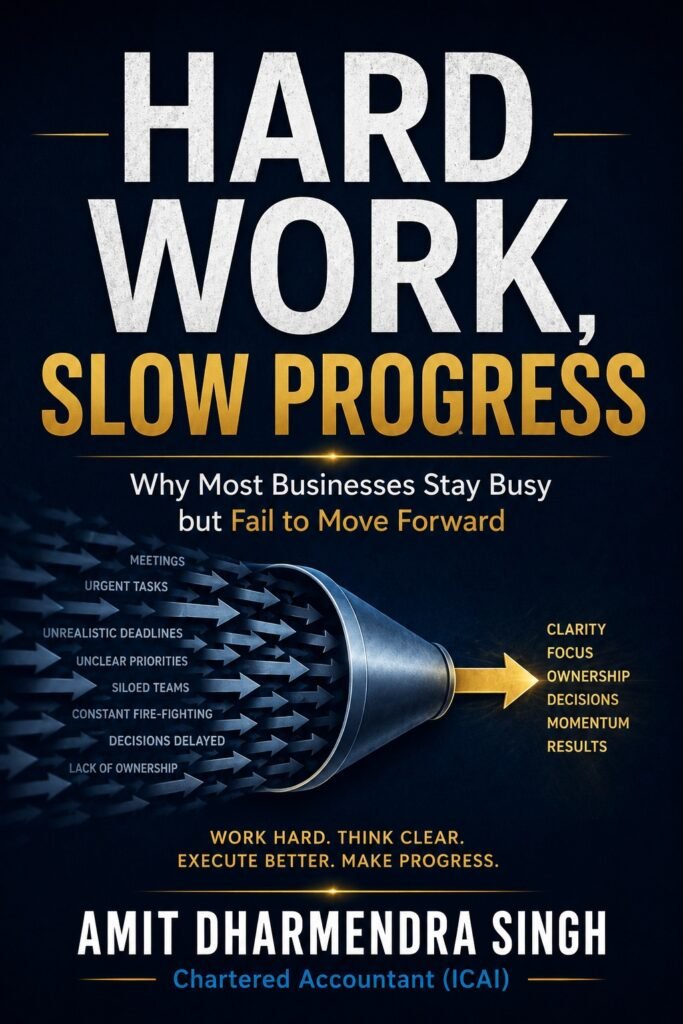
Why most businesses stay busy but fail to move forward
Hard Work, Slow Progress explores why businesses can be full of activity yet struggle to move forward. It examines how unclear priorities, blurred ownership, open decisions, constant follow ups, and unfinished work quietly drain momentum. The book focuses on restoring flow so effort leads to steadier and more meaningful progress.
Available Languages & Formats
🇬🇧 English
✅ Kindle
✅ Paperback
✅ Hardcover
✅ Audiobook
Buy on Amazon
Select your preferred Amazon marketplace below. Availability varies by language and format.
If your country is not listed below, you can purchase from Amazon.com (US) or your nearest available Amazon marketplace. Kindle editions can usually be delivered worldwide, subject to Amazon regional availability.
🇬🇧 English
📖 Buy the Book on Amazon – US | UK | DE | FR | ES | IT | NL | JP BR | CA | MX | AU | IN
🎧 Listen on Audible – Audible
What You’ll Learn
Hard Work, Slow Progress helps you understand why businesses can have capable people, high levels of activity, and genuine effort, yet still struggle to move forward.
In this book, you will learn how to:
- Recognise the difference between being busy and making real progress
- Understand how competing priorities quietly slow execution
- Identify ownership that exists on paper but not in daily practice
- See why urgent work repeatedly replaces important work
- Recognise the hidden cost of decisions that remain open too long
- Understand why meetings and constant follow ups can create activity without movement
- Identify when shared responsibility creates confusion instead of accountability
- Recognise when the owner becomes the bottleneck
- Understand why capable teams can remain busy but poorly aligned
- See how unfinished work and open loops gradually weaken momentum
- Understand what changes when work begins to flow with greater clarity and continuity
Who Should Read This Book?
This book is designed for people who work hard inside a business but feel that progress should be faster than it is.
It is ideal for:
- Business owners who feel heavily involved but still see slow progress
- Managers responsible for turning activity into meaningful results
- Leadership teams dealing with competing priorities and unclear ownership
- Founders who find themselves constantly following up and resolving bottlenecks
- Leaders managing capable teams that remain busy but lack alignment
- Growing businesses where increasing complexity has made execution feel heavier
- Anyone who wants to understand why effort does not always translate into momentum
Key Topics Covered
Hard Work, Slow Progress examines the everyday execution patterns that quietly drain momentum from otherwise capable businesses.
Topics covered include:
- Why hard work no longer feels effective
- When everything is important and nothing moves
- How unclear priorities slow the business
- Ownership that exists on paper but not in practice
- Why urgent work keeps replacing important work
- Decisions that stay open too long
- Meetings that create activity instead of progress
- The hidden cost of constant follow ups
- The problem with decisions that become everyone’s responsibility
- When the owner becomes the bottleneck
- Teams that are busy but not aligned
- Work that looks necessary but leads nowhere
- Why momentum feels fragile even when teams are capable
- Closing loops and restoring momentum
- What changes when work starts to flow
Why I Wrote This Book
I wrote Hard Work, Slow Progress because I have repeatedly seen businesses where people are working hard, staying involved, attending meetings, completing tasks, and responding to problems, yet progress still feels slower than it should.
The problem is rarely a lack of commitment or intelligence.
More often, work simply does not move.
Priorities compete. Ownership becomes unclear. Decisions remain open. Important work gets pushed aside by urgent demands. People follow up constantly because work does not close cleanly.
Over time, the business becomes active without becoming more effective.
I wanted to explore why this happens.
This book is not about asking people to work harder. It is not about productivity hacks, motivational techniques, or complex execution systems.
It is about looking at how work actually flows through a business and recognising the patterns that quietly create friction.
Because progress does not always require more effort.
Sometimes, it requires fewer things competing, clearer ownership, decisions that close, and work that is allowed to move forward without constant interruption.
The aim of this book is simple: to help business owners and leaders see what is slowing movement and understand how clarity can restore momentum to the work their people are already doing.
Inside the Book
Hard Work, Slow Progress explores why capable business owners and teams can remain constantly busy yet struggle to create meaningful forward movement. The book examines the hidden patterns that slow execution and shows how clarity, ownership, decisions, and completion shape momentum inside a business.
Chapter 1: Why Hard Work No Longer Feels Effective
Understand why increasing effort does not always produce better results and how businesses gradually reach a point where people work harder while progress slows.
Chapter 2: When Everything Is Important, Nothing Moves
Explore how too many competing priorities divide attention, weaken execution, and make meaningful progress difficult.
Chapter 3: How Unclear Priorities Quietly Slow the Business
See how a lack of clear direction causes teams to spend time on work that feels necessary but does not move the business forward.
Chapter 4: Ownership That Exists on Paper, Not in Practice
Understand why assigned responsibilities often fail to create real accountability and how unclear ownership causes work to stall.
Chapter 5: Why Urgent Work Keeps Replacing Important Work
Examine how businesses become trapped in constant reaction, allowing immediate problems to repeatedly replace work that creates long term progress.
Chapter 6: Decisions That Stay Open Too Long
Learn how delayed and unresolved decisions create hesitation, slow projects, and leave too many issues competing for attention.
Chapter 7: Meetings That Create Activity, Not Progress
Explore why frequent discussions do not always lead to movement and how meetings can create the appearance of progress without real outcomes.
Chapter 8: The Hidden Cost of Constant Follow Ups
See how repeated reminders and checking become a substitute for clear systems, creating unnecessary pressure for both owners and teams.
Chapter 9: The Cost of Decisions That Are Everyone’s Responsibility
Understand why shared responsibility can often mean no real responsibility and how unclear decision ownership slows execution.
Chapter 10: When the Owner Becomes the Bottleneck
Examine how excessive owner involvement can gradually limit business momentum, even when that involvement comes from good intentions.
Chapter 11: Teams That Are Busy but Not Aligned
Discover why capable people can work hard in different directions and how lack of alignment quietly weakens collective progress.
Chapter 12: Work That Looks Necessary but Leads Nowhere
Learn to recognise activity that consumes time and energy without creating meaningful outcomes or improvement.
Chapter 13: Why Momentum Feels Fragile Even When Teams Are Capable
Explore why progress can disappear quickly when execution depends on constant pressure rather than clear and repeatable patterns.
Chapter 14: Closing Loops and Restoring Momentum
Understand why unfinished tasks and unresolved decisions create drag and how consistent completion restores flow to the business.
Chapter 15: What Changes When Work Starts to Flow
See how businesses begin to feel lighter when priorities become clearer, ownership strengthens, decisions close, and work moves without constant intervention.
Frequently Asked Questions
Hard Work, Slow Progress is written for business owners and leaders who work hard, remain deeply involved, and still feel that progress should be faster. It focuses on why work becomes heavy and momentum slows even when people are capable and committed.
1. What is Hard Work, Slow Progress about?
Hard Work, Slow Progress explores why businesses can remain busy without moving forward at the same pace. It examines everyday execution patterns involving priorities, ownership, decisions, follow ups, meetings, unfinished work, and leadership involvement that quietly slow momentum.
2. Is this book about productivity techniques or time management?
No. Hard Work, Slow Progress is not a book about productivity hacks, time management systems, or motivation techniques. Its focus is on understanding how work actually moves through a business and identifying the patterns that create friction and slow execution.
3. Who should read this book?
Hard Work, Slow Progress is particularly relevant for business owners, entrepreneurs, senior managers, and leaders who feel constantly involved in operations but are frustrated that effort is not translating into the level of progress they expected.
4. Does the book blame employees or management for slow progress?
No. Hard Work, Slow Progress does not focus on blame. It examines structural and behavioural patterns that develop inside businesses over time, including unclear priorities, diluted ownership, delayed decisions, and unfinished work.
5. Why does the book focus so much on clarity?
Because many execution problems do not begin with a lack of effort. They begin when people are unclear about what matters most, who owns a decision, what needs to be completed, or when an issue is truly closed.
6. What does the book say about the role of the business owner?
Hard Work, Slow Progress explores how owners often become increasingly involved when work slows down. While this can temporarily solve problems, constant intervention can eventually make the owner the point through which too many decisions and actions must pass.
7. Is the book a step by step business improvement framework?
No. Hard Work, Slow Progress intentionally avoids presenting a complex framework or rigid system. Instead, it encourages readers to observe how work flows inside their business and recognise where friction is quietly slowing movement.
8. What is the central idea of the book?
The central idea is simple: progress does not always require more effort. Often, it requires better flow. When priorities are clear, ownership is understood, decisions close, and work reaches completion, momentum can return without constantly pushing harder.
About the Author
Amit Dharmendra Singh is a Chartered Accountant (ICAI), DISA (ICAI), Finance Executive, Author, and AI in Finance Advocate with more than 23 years of international leadership experience across India, Thailand, and Saudi Arabia. His work focuses on corporate finance, cash flow management, working capital optimization, business transformation, and artificial intelligence in finance.
Through his books, Amit shares practical frameworks and real world insights that help finance professionals, business leaders, and entrepreneurs make better financial decisions and build stronger organizations.
Related Books
📘 Decision Speed
Learn how organisational delays, unclear ownership, information gaps, and slow decision processes affect business momentum and performance.
📘 Where Profit Really Comes From
Learn how everyday business decisions shape profit long before the numbers appear.
📘 Calm Leaders Build Strong Businesses
Learn how calm leadership stabilises teams, decisions, and performance under pressure.
📘 The Growth Cash Trap
Learn how growth can quietly create cash pressure through inventory, hiring, credit, and expansion.
📘 Simple Rules Beat Smart Plans
Learn why simple operating rules can protect margins, strengthen decision discipline, and maintain momentum.
📘 How Strong Businesses Actually Work
Learn how structure, behaviour, timing, and discipline work together to create strong and resilient businesses.
Continue Your Learning
Continue your finance leadership journey with more books, articles, and resources.
Explore More
📚 Explore My Books
Discover the complete collection of books on finance, leadership, artificial intelligence, business strategy, and international trade.
📝 Read the Blog
Explore practical articles, insights, and real world perspectives on corporate finance, cash flow, working capital, AI, and business transformation.
👤 About the Author
Learn more about Amit Dharmendra Singh, his professional journey, and the experience behind every book.
📩 Contact
Have a question, feedback, or would like to connect? Get in touch through the contact page.
→ Contact